954,315 Members — Technology Publication meets Social Media
Username:
Password:
Lost login information?

The truth about Apple and Android market share

0
By Davey Winder on Jan 23rd, 2012 7:42 pm

Is Apple really 'closing the gap' on Android as far as smartphone market share is concerned, or is there more to the battle of the mobile handsets than the latest set of headline figures suggest?

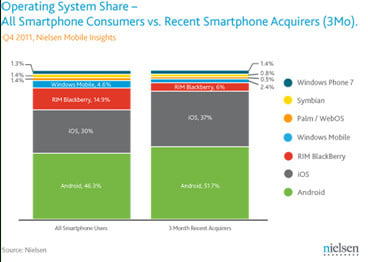
androidshare.jpg Certainly if you take the research, and associated press releases surrounding it, from Nielsen regarding smartphone sales then you might be forgiven for thinking that Android handsets are in danger of being overtaken by iPhones in terms of handsets in, well, hands. The NeilsenWire release in question doesn't help by loudly proclaiming "More US Consumers Choosing Smartphones as Apple Closes the Gap on Android" - a headline which has been copied by news media outlets pretty much word for word in many cases, although some have opted to leave the 'consumer' bit out, and a sentiment which has certainly been echoed as if Gospel in the vast majority of those news stories which I have bothered to read.

The Nielsen research points at the launch of the iPhone 4S in the back half of last year as the driver for this apparent 'surge' in Apple smartphone popularity, which is hardly surprising in my opinion. After all, just look at the media feeding frenzy whenever Apple throws any new product into the pool. The TV coverage bordered on the insane, especially considering that 'new' in the case of the 4S (which, I should point out before I get accused of Apple bashing, I own myself and am more than happy with) actually turned out to be 'much the same as before with a few additional tweaks' truth be told. Nielsen reports that 44.5 percent of folks asked in December said they had opted for an iPhone (and 57 percent of those an iPhone 4S) compared to 25.1 percent back in October.

So, taken at face value you could say that there had been a surge in iPhone popularity, yes. As far as consumers, and US-based consumers at that, are concerned the iPhone 4S effect has had an impact on the Android market share as measured by the Nielsen reporting metric. Android saw a drop from 61.6 percent market share to 46.9 percent between October and December 2011, while iPhones jumped up from 25.1 percent to finish the year just behind the Androids on 44.5 percent.

Part of the problem in taking these numbers and concluding that the iPhone is about to seriously kick some Android ass, is that human nature is such that people will hold back from buying an iPhone until the 'new' model is released. Media coverage continues for months before the actual product is available, in effect depressing iPhone sales until the launch happens when, boom, a flurry of activity boosts the numbers up. The other part of the problem is that the Nielsen numbers relate to the percentages buying new smartphones, not the actual market share at all. All that increased were the number of people buying new iPhones (on the back of a new model launch) compared to those buying new Androids, during a three month period leading up to Christmas.

The truth is that both Apple and Android are doing well, especially when you take a slightly broader look that includes global business and tablet users; and with more than 250 million Android devices activated so far (50 million of them in the last couple of months alone) Google is far from out of the race or even flagging noticeably. You simply cannot take information that addresses a short term snapshot of a particular section of the market and somehow extrapolate from that, as some media outlets have done, that one player is about to capture a bigger slice of the overall market share...
As some wag once observed, "There are lies, damned lies, and then there are statistics!". One could make the case that most people think breathing is bad for your health, assuming you leave off (or minimize) the fact that the study was what people think about breathing truck exhaust fumes...

rubberman
Posting Virtuoso
1,561 posts since Mar 2010
Reputation Points: 277
Solved Threads: 179
 

You forget another effect, and a big one, that's especially prevalent in Apple buyers: replacement envy.

Many of them will buy every single new Apple device that gets released, whether it is an improvement (let alone an improvement warranting the cost of replacement on any objective basis) or not.
Thus I would estimate that possibly as many as 75% of iPhone 4S models sold are replacements for older iPhones (and most of them for iPhone 4 models).
While this happens to a degree in the Android market as well, it's not nearly as big an effect (and where it happens it's often people skipping to another Android vendor because of problems with an older device, or because of a major leap in functionality).

jwenting
duckman
Team Colleague
8,392 posts since Nov 2004
Reputation Points: 1,662
Solved Threads: 337
 

I think you have a good point there, not least as I currently have an iPhone 4 (couple of months left on contract) and an iPhone 4S. Erm, guilty as charged methinks :)

happygeek
Freelance Word Punk
Administrator
27,465 posts since Mar 2006
Reputation Points: 1,457
Solved Threads: 55
 

Apple is the sole manufacturer of the proprietary iPhones. They don't offer a variety of phones to fit different needs, they offer one phone style that is flexible enough to do just about everything. New releases are rare events that stir up demand.

Android is open-source software backed by Google. Several manufacturers compete to fill niches, hit pricing points or try to dominate the market with innovative hardware. Androids can look like iPhones. There are always new releases of Android phones.

Buying an iPhone is simply a yes/no decision (do I want it?) while someone who shops specifically for an Android has to decide which Android version, manufacturer, phone and design is best. The more complicated the decision gets, the less likely the sale is made - especially if it's to replace a phone that's still working.

But a lot of buyers probably don't start by deciding between an iPhone or an Android. Instead, they probably look at a lot of phones and narrow down their choices. From that perspective, iPhones are just one style of phone out of the many that are Androids.

Both the iPhone and Androids have more capabilities that most people need or will use. As more people buy and get used to Androids, they'll show them off and create more demand. Androids will keep gaining market share because they aren't a single phone controlled by a single company that has only offered a few models over the last five years.

Both types of phones can run thousands of apps to extend uses and functionality. Users like to customize their phones according to their needs; but they also want a phone that looks right, feels rights and operates smoothly. Market forces and competition have allowed manufacturers and software developers to build appealing versions of Android phones that keep innovation moving along at a steady pace.

dave27johnson
Newbie Poster
7 posts since Apr 2008
Reputation Points: 10
Solved Threads: 0
 

This article has been dead for over three months

Post: Markdown Syntax: Formatting Help
You
View similar articles that have also been tagged: