This problem is to print a square using a number that the user enters, which would be in the center. If the user entered a 5, then the program should output this:
111111111
122222221
123333321
123444321
123454321
123444321
123333321
122222221
111111111
If you're wondering, this was not a homework assignment. It was on a quiz, and I did not know how to do it. So if someone could give me at the very least some guidance on how to solve this problem, then that'd be nice. I know that I need to use for loops, but I'm not quite sure how. Thank you for your time and assistance.

rfrapp
17
Junior Poster in Training
Recommended Answers
Jump to PostSeemingly, the number has to be between 1 and 9, right?
...but if this is on a quiz, why would you want someone else to answer it?
Jump to PostThe program sounds fun so I did it myself..used a whole mess of if else statements inside an inner loop...though the program might be simplified if you use a recursive function but I'm not sure how to do this yet
Jump to PostI really do like programming, it's just that the problem solving part is difficult for me.
I have devastating news for you.
I forgot to mention that I'm relatively new to C++, and I have no idea what most of that means :p
Don't fret. I've been using C++ for …
Jump to PostYou can start by reading the Daniweb Posting Rules. Then you can Read This Before Posting a Question. You also might want to read everything that has already been posted in this thread.
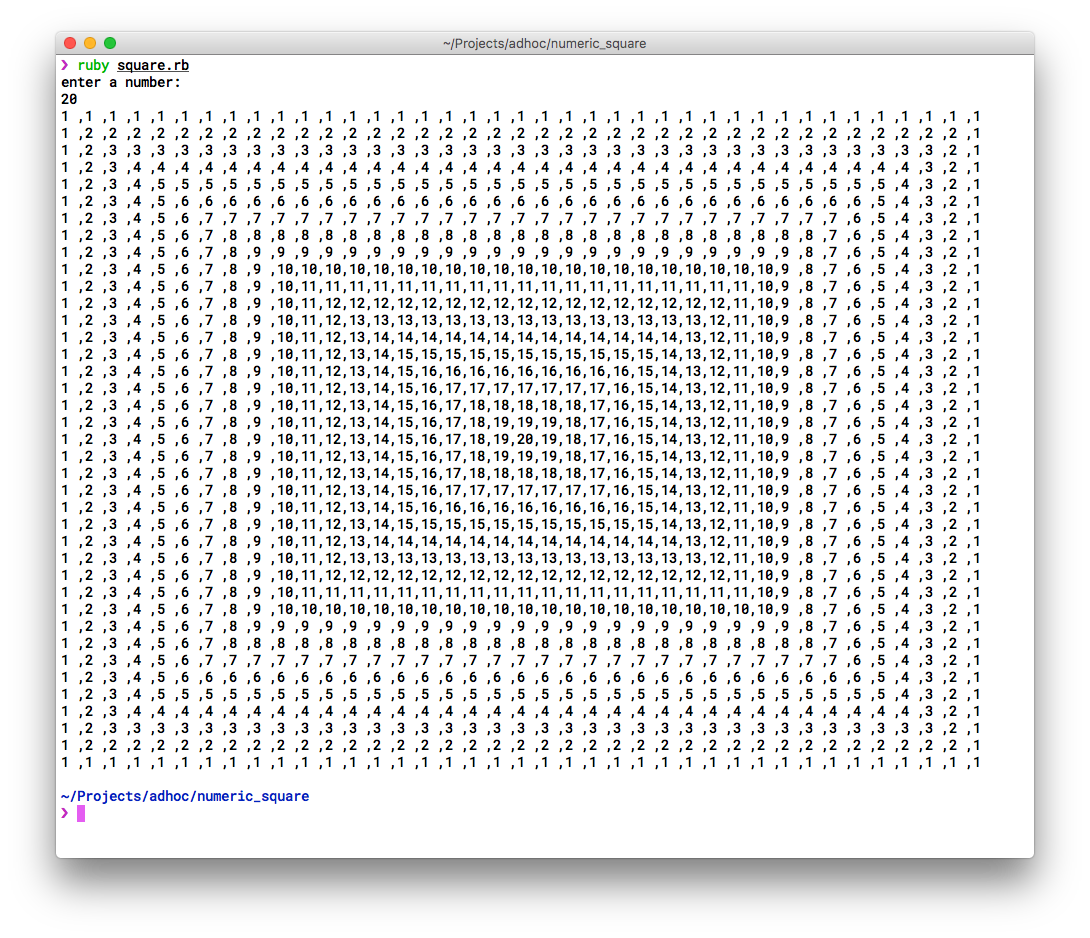
Jump to PostThis looked interesting so I had a go. Did it in Ruby so it wouldn't be of use to anyone with Java, C or C++ homework :)
puts "enter a number:"
number = gets.to_i

# calculate the dimensions of the square
length = ((number-1) * 2) + …
All 17 Replies

thines01
401
Postaholic
Team Colleague
Featured Poster

zeroliken
79
Nearly a Posting Virtuoso
thines01
401
Postaholic
Team Colleague
Featured Poster
rfrapp
17
Junior Poster in Training
rfrapp
17
Junior Poster in Training

WaltP
2,905
Posting Sage w/ dash of thyme
Team Colleague
rfrapp
17
Junior Poster in Training
Dman01
10
Light Poster

Tumlee
42
Junior Poster in Training
WaltP
2,905
Posting Sage w/ dash of thyme
Team Colleague
MandrewP
60
Junior Poster in Training
Tumlee
42
Junior Poster in Training

m4ster_r0shi
142
Posting Whiz in Training
WaltP
commented:
If not, maybe the instructor isn't ready to teach them...
-4
m4ster_r0shi
142
Posting Whiz in Training

Armugam Rajashekar
0
Newbie Poster

Reverend Jim
4,780
Hi, I'm Jim, one of DaniWeb's moderators.
Moderator
Featured Poster

pty
882
Posting Pro
Be a part of the DaniWeb community
We're a friendly, industry-focused community of developers, IT pros, digital marketers, and technology enthusiasts meeting, networking, learning, and sharing knowledge.