Does the *thing* have to be the source of the emitted vibration? I mean... any object could emit vibration if you consider reflected light as being emitted vibration.
And a Dr. Pepper can will emit vibration if you squeeze it. The crinkling aluminum produces the vibration of sound waves.
Well, how sensitive do we have to be to the vibration. Protons and Electrons are in motion in atoms. Would there not be some molecular vibration on anything made of this matter?
All things emit vibrations so they exist.(e.g. in the form of heat)
So I'm entering a pub, lots of people, going to meet a friend to have a drink. I look around and I see my friend is not there yet. Can I tell now that my friend exists?
>Can I tell now that my friend exists?
I think a more interesting question is how many people will question your sanity if you have a friend that you aren't sure exists? :)
Assumptions:
vibrations, matter, particles
Definitions:
Zero Kelvin is defined as the state in which all particle motion ceases and entropy is zero/infinite
All vibration ceases at Zero Kelvin;
All 'things' are made of matter;
All matter is made up of particles that vibrate;
therefore
All 'things' that do not vibrate
either
Do not exist
or
exist at Zero Kelvin.
Assumptions:
vibrations, matter, particles
Definitions:
Zero Kelvin is defined as the state in which all particle motion ceases and entropy is zero/infinite
All vibration ceases at Zero Kelvin;
All 'things' are made of matter;
All matter is made up of particles that vibrate;
therefore
All 'things' that do not vibrate
either
Do not exist
or
exist at Zero Kelvin.
Great , so can we say universe cease to exist when it stops vibrating and when it starts vibrating again it comes into existence ?
The answer lies in the question.
Consider vibration to be pendulum-like and the universe disappears at the apogee of each arc for that moment when acceleration is infinite (or undefined - you decide) and velocity is zero.
Consider string theory in which particles are composed of 'strings' that have only 2 dimensions (and yet create a universe of 11 dimensions) and vibrate all the time.
Consider the universe as a particle that is pendulum-like in a higher dimension and what we see as the big-bang followed by the big-compression as just a tic/toc in the time of a meta-universe.
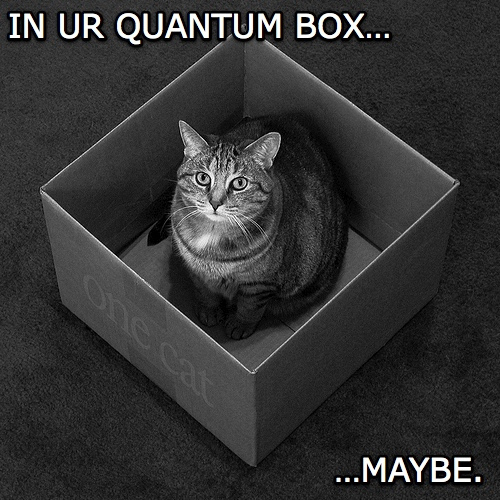
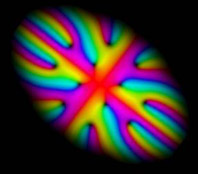
Consider absolute zero (again - back to this because it is so much fun) - we can't get there from here but we can get to 200 degs K and at that point we suddenly see Bose-Einstein condensate. The particles have slowed down to about half a mile per hour (from 1100 mph at room temp) they become superfluids that have little or no friction but still have surface tension which could lead to liquids that when left in a bowl will flow up the sides and out; but the real use of a BEC is coherence but the fun thing about BEC is quantum de-coherence (sometimes called the quantum Zeno effect after the Zeno paradoxes ) in which you have slowed the system down so much that you can take measurements (ie "watch") the system so much that you can prevent changes in the quantum system (sometimes called suppression of unitary time evolution). If you can prevent Zeno's Arrow from moving, you can prevent changes in the system and, er, save Schroedinger's Cat.
but I digress - (attached: Schroedinger's lolcat and a mathematical model of a coherent atom)
All vibration ceases at Zero Kelvin;
All 'things' are made of matter;
All matter is made up of particles that vibrate;
therefore
All 'things' that do not vibrate
either
Do not exist
or
exist at Zero Kelvin.
Wrong!!. You are only considering classical phenomena but quantum mechanics has more to say. At absolute zero kelvin, the motion does not ceases and the maximum velocity of a electron corresponds to the kinetic energy equal to the Fermi Energy .
To quote from the link:
even if we have extracted all possible energy from a metal by cooling it down to near absolute zero temperature (0 kelvins), the electrons in the metal are still moving around; the fastest ones would be moving at a velocity that corresponds to a kinetic energy equal to the Fermi energy. This is the Fermi velocity.
Even the entropy is not zero for non perfectly-crystalline/ solids at zero kelvin. This is called Residual Entropy . Ice, for example has a residual entropy of 3.4J/K/mol.
Wrong!!. You are only considering classical phenomena but quantum mechanics has more to say. At absolute zero kelvin, the motion does not ceases and the maximum velocity of a electron corresponds to the kinetic energy equal to the Fermi Energy .
To quote from the link:
Even the entropy is not zero for non perfectly-crystalline/ solids at zero kelvin. This is called Residual Entropy . Ice, for example has a residual entropy of 3.4J/K/mol.
Did you not read the first 4 lines?Assumptions:
vibrations, matter, particles
Definitions:
Zero Kelvin is defined as the state in which all particle motion ceases and entropy is zero/infiniteActually, I had not even heard of Fermi Energy - thanks for the links!
I especially like the part about "...frustration... may lead to highly degenerate ground states with a nonzero entropy at zero temperature. This implies that if we were to send the crystal lattice to a 'massage parlor' it would end up with zero entropy at zero temperature.
My explanation is perfectly valid for perfect particles and even real particles.
You have defined zero kelvin as the temperature at which all the motion ceases. But actually, this very definition is not correct as viewed by the spectacles of quantum mechanics.
>This implies that if we were to send the crystal lattice to a 'massage parlor' it
>would end up with zero entropy at zero temperature.
Not likely, the Residual Entropy is the consequence of the basic arrangement of poly-atomic molecules. That mean, that even if you send your latice to a perfection parlor, they would still have residual entropy left.(Until and unless they are broken into individual atoms).
>WRT your avatar.
Didn't got this one? My avatar is the Glider , emblem of Hackerdom as suggested by Eric S. Raymond .
Yes, it is taken from Game of Life
Hi. You are certainly correct in saying that even at 0 K a quantum system still contains energy. However, a quantum system in it`s ground state cannot emit any energy because the ground state is defined as the lowest possible energy state of the system. All it can do is wait around to see if it is able to absorb some energy. The emission of photons can be considered the emission of vibrations in the electromagnetic field. Here we have a system that does not emit vibrations of this kind and, as far as I know, could not emit vibrations of any kind. I warrant that the original point has been disproven.
>Here we have a system that does not emit vibrations of this kind and, as far as
>I know, could not emit vibrations of any kind.
Don't try to go to the classical model again. That is, if a (charged) particle is not emitting any radiations, it is not vibrating. This assertion is not valid in quantum mechanics (say, if this was true, there would be no atoms since they are vibrating but doesn't give out radiation in stable state).
I fully agree that the system at zero kelvin cannot give out any EM radiations(or any other way in which its energy decreases). But that doesn't implies that it would not be vibrating!
So I can infer is:
1. All particle will vibrate (at least move),
2. Even at zero kelvin.
>WRT your avatar.
Didn't got this one? My avatar is the Glider , emblem of Hackerdom as suggested by Eric S. Raymond .
Yes, it is taken from Game of Life
What don't you get? The glider is the basis of a lot of things in life and in life.