@iamthwee
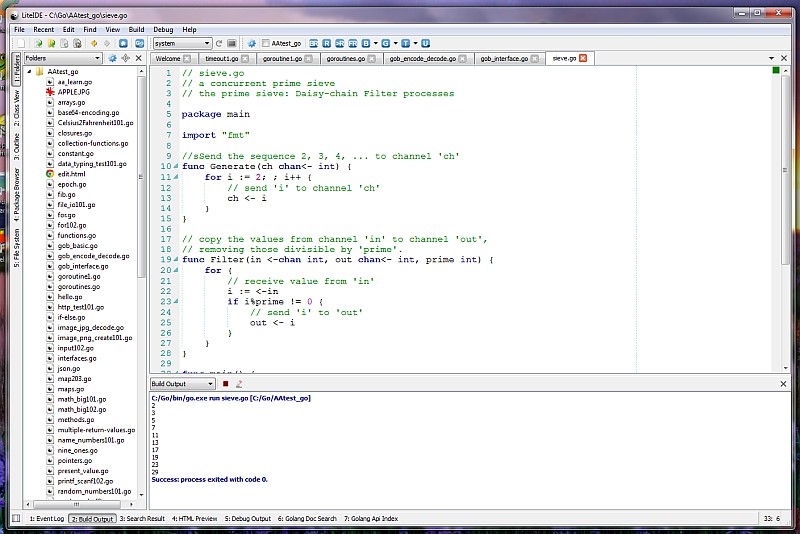
A screenshot of LiteIDE, the open source, cross platform Go IDE from:
https://github.com/visualfc/liteide
@iamthwee
A screenshot of LiteIDE, the open source, cross platform Go IDE from:
https://github.com/visualfc/liteide

Here is the Go code I was working with, a nice example of concurrent computing ...
// sieve.go
// a concurrent prime sieve
// the prime sieve: Daisy-chain Filter processes
package main
import "fmt"
// send the sequence 2, 3, 4, ... to channel 'ch'
func Generate(ch chan<- int) {
for i := 2; ; i++ {
// send 'i' to channel 'ch'
ch <- i
}
}
// copy the values from channel 'in' to channel 'out',
// removing those divisible by 'prime'.
func Filter(in <-chan int, out chan<- int, prime int) {
for {
// receive value from channel 'in'
i := <-in
if i%prime != 0 {
// send value 'i' to channel 'out'
out <- i
}
}
}
func main() {
// create a new channel
ch := make(chan int)
// launch Generate goroutine
go Generate(ch)
// get the first 10 primes
for i := 0; i < 10; i++ {
prime := <-ch
fmt.Println(prime)
ch1 := make(chan int)
go Filter(ch, ch1, prime)
ch = ch1
}
}
/*
2
3
5
7
11
13
17
19
23
29
*/
The for loop is the only loop in Go but it covers all the possible loops.
Comparing C/C++ and Go types:
+--------------------+------------------+
| C/C++ type | Go type |
+--------------------+------------------+
| bool | bool |
| char | byte |
| signed char | int8 |
| unsigned char | byte |
| short | int16 |
| unsigned short | uint16 |
| int | int |
| unsigned int | uint |
| long | int32 or int64 |
| unsigned long | uint32 or uint64 |
| long long | int64 |
| unsigned long long | uint64 |
| float | float32 |
| double | float64 |
| char * or char [] | string |
+--------------------+------------------+
Still no GUI toolkit for Go.
@iamthwee,
you not only got me hooked on Go, but also Shoes!
Darn you anyway! :)
We're a friendly, industry-focused community of developers, IT pros, digital marketers, and technology enthusiasts meeting, networking, learning, and sharing knowledge.