Hello;

can any 1 explain to me how to find the miniumum spanning tree for a graph ?


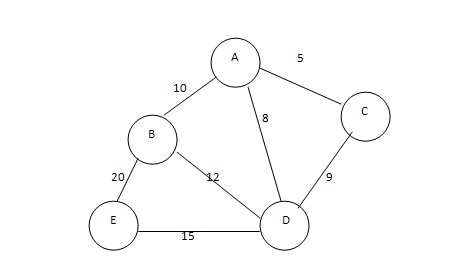
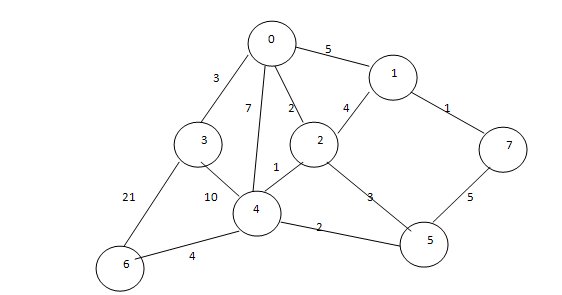
see this graph as an example :

Dani AI

Generated

As 's post shows, a short, exam-friendly recipe is often more useful than long theory. Building on 's pointer to standard MST methods and 's visualization idea, a compact, practical approach is given below (no external links).

A fast hand method (edge-sorting / Kruskal-style):

  • List every edge and sort by increasing weight.
  • Track components (initially each vertex alone).
  • Scan edges from smallest to largest: if an edge connects two different components, add it to the tree and merge those components; if it would close a cycle, skip it.
  • Stop when exactly V-1 edges have been taken (for a connected graph). For disconnected graphs this produces a minimum spanning forest.
  • Equal-weight edges: any tie-breaking that avoids cycles is fine; multiple MSTs can exist.

A minimal C++-style sketch (concept only):

struct DSU { vector<int> p, r; DSU(int n):p(n){iota(p.begin(),p.end(),0);} int find(int x){return p[x]==x?x:p[x]=find(p[x]);} bool unite(int a,int b){a=find(a); b=find(b); if(a==b) return false; p[b]=a; return true;} };
struct Edge{int u,v,w;};
sort(edges.begin(), edges.end(), [](auto &a, auto &b){ return a.w < b.w; });
DSU d(n);
for(auto &e: edges) if(d.unite(e.u,e.v)){ mst.push_back(e); total += e.w; if(mst.size()==n-1) break; }

Quick tips: Kruskal is easy to implement and hand-simulate; Prim (the grow-from-a-vertex method) is better for dense graphs or adjacency-matrix code. MSTs require undirected weighted graphs; for directed graphs the problem is different.

Recommended Answers

All 9 Replies

There are several ways. Not to mention that graph algorithms tend not to be trivial, so you'd be better off studying existing solutions, like Prim or Kruskal's algorithms.

i do not know these algorithms
we just studying Chapter of graph quickly and with out coding.

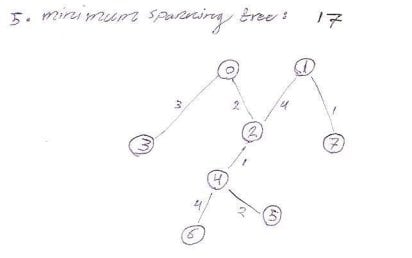
but see this solved example :

> i do not know these algorithms
You would have to learn them to solve the problem at hand. Try the wikipedia. It should help you in getting started at least.

>i do not know these algorithms
Which is why I suggested that you study them. If you did know them, you wouldn't be asking how to find a minimum spanning tree. Really, is Google that difficult to use?

>i do not know these algorithms
Which is why I suggested that you study them. If you did know them, you wouldn't be asking how to find a minimum spanning tree. Really, is Google that difficult to use?

and it's so difficult to learn some one don't know !

what can i do if teachers don't explain it , and there is no time to search and search .

But the fact remains that you _do_ have to study them by hook or by crook. Otherwise how do you expect to clear the test?

is a site which would help you in learning them with those pretty visualizations.

>and it's so difficult to learn some one don't know !
I gave you the exact name of two algorithms that find a minimum spanning tree. What more do you want? Me to write up two super easy implementations and describe how every line works? I didn't feel the need to do that when just about every result from Google has sample code.

>what can i do if teachers don't explain it , and there is no time to search and search .
http://en.wikipedia.org/wiki/Prim's_algorithm
That's the first result from Google. It took me about 5 seconds to search and search. Stop being a weenie and show some effort.

ohh,

stop it plz

sorry sr for wasting your time in typing

and thanks for the algorithm's name

There is a good software for solving travelling salesman problem and searching the minimal spaning tree at www.susaninlab.com

Be a part of the DaniWeb community

We're a friendly, industry-focused community of developers, IT pros, digital marketers, and technology enthusiasts meeting, networking, learning, and sharing knowledge.