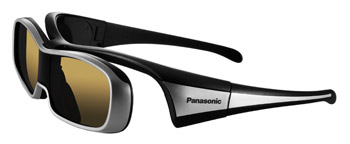
On March 10th Panasonic teamed up with Best Buy, DIRECTV and Twentieth Century Fox Home Entertainment to offer consumers a "Full HD 3D" home theater system. The set includes a 50-inch class (49.9” measured diagonally) Panasonic VIERA VT20 Plasma 3D HDTV and a Panasonic BDT300 3D Blu-ray Disc Player and it retails for $2899.99. For that price you also get one [yes just one] pair of 3D glasses. The glasses look great, resembling high-tech sunshades but in my opinion they cost too much [around $150 a pop]. The first customer to purchase this set from Best Buy’s store in Union Square, New York received one year of free programming from DIRECTV. According to Bloomberg’s BusinessWeek article today , Panasonic has already sold out its 3-D Televisions in U.S. stores. Consumers are buying into the notion that 3-D content will be widely available soon. We can expect movies like and to be available in 3D Blu-ray. DIRECTV said it will offer 3D pay-per-view and on demand channels. The 2010 FIFA World Cup [of soccer] has partnered with Sony to deliver 3D images from up to 25 matches. Imagine penalty kicks from the goalie’s perspective in 3-D, w00t! But wait…
All that sounds great but how great is 3D technology at this point?
I visited the Consumer Electronics Show (CES) in January of this year, where 3D televisions were one of the main topics of the show. All of the major players were their touting their new 3D offerings and I tried most, if not all of them. . Considering that it is a relatively old technology (over 100 years) I think it should be more mature by now. I am sure I am not the only one who is disappointed about having to wear glasses to view something in 3D, though the glasses look better and do not give me much of a headache anymore.
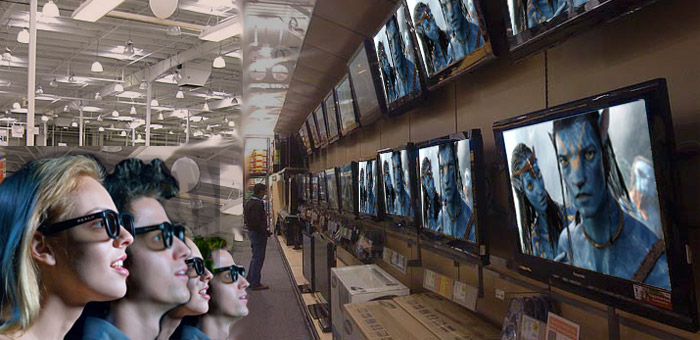
Funny thought - Imagine people shopping for 3D TVs, this can be the scene at your local electronics store soon:
So what is the good news?
The good news is that usually whenever something goes main stream it gets better and cheaper. Therefore it is with some hesitation that I say let’s check out 3D TV, those of you who have extra cash please do the rest of us a favor and buy buy buy so the manufacturers can spend more on improving 3D. Perhaps in three to five years we will be able to remove our [3D] glasses. Think about it, people spend $2000 for laser eye surgery so they can dump their glasses, then go buy a 3D TV setup for $3000 just so they can put glasses back on their face. Really?
I welcome you to share your thoughts below. I’m especially interested in hearing from anyone who has a 3D TV or has used one extensively (spending two hours watching a movie at your local Best Buy does not count).