South Korea beats China, USA and UK in 2012 malware medal table

Updated happygeek 1 Tallied Votes 457 Views Share

China may be odds-on to top the medal table at the London 2012 Olympic Games, with less than a week to go, but according to a new report South Korea has the Chinese well and truly beaten as far as malware infected PCs are concerned. And unlike at the Olympic Games where the USA and Great Britain are ahead of Korea in the medal tables currently, both America and Britain are nowhere to be seen in the top ten most malware infected countries, and the UK actually makes it into the 'least infected' listings.
dweb-southkorea

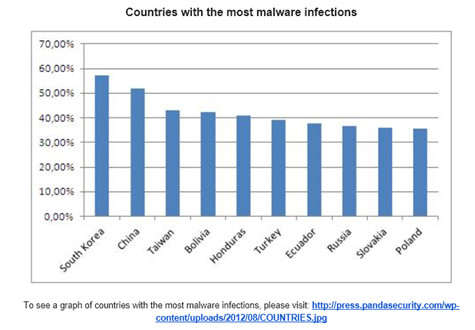
The latest Panda Security antimalware labs quarterly report reveals that, for the first time ever, South Korea is top of the medal table when it comes to the numbers of malware infections per country. The report, covering the period between April and June 2012, shows that while the average number of infected PCs globally speaking is down by nearly 4% at 31.63%, the number in South Korea is a staggering 57.3% which is up by nearly 3% on the previous quarter. It is also head of China on 51.94%, with Taiwan and Bolivian some way behind these two in third and fourth places respectively. The least infected country is Switzerland with an average of 'just' (and I use that word with my teeth gritted as it is still way too high) 18.4% followed by Sweden on 19.07% - sadly no other countries could manage to drop below the 20% figure.

Looking at the report in depth, Pandalabs discloses that most of the new threats were rather unsurprisingly of the Trojan variety, accounting for some 78.92% of the total. Worms on 10.78% and viruses on 7.44% look like they are almost forgotten, by comparison, in second and third places on the list. Interestingly, the days of adware and spyware could soon be over, as only 2.69% of the new threats revealed in the analysis fell into the sub-category. Viruses had also fallen quite considerably from the report published this time last year, down from 14.24%, but worms are on the up - rising from 9.3% in the last quarter.

Trojans also, again without any hint of surprise at all, accounted for the largest number of infected PCs with 76.18% which is up from 66.03% last quarter. Viruses accounted for 7.82% of infections and worms 6.69% - the latter figure being interesting as the actual infection rate is well below the new threats detected rate which suggests that, as far as worms are concerned anyway, security software is doing a reasonable job in holding back the threat tide.

Dani AI

Generated

Good thread, — the PandaLabs item started a useful conversation, but the raw “most‑infected country” headline needs context. Vendor country rankings come from each vendor’s telemetry (who uses their product, which samples they see, what they count as an infection) and so can be skewed by sampling and reporting choices; they’re a signal, not a census. (sciencedirect.com)

Observers often point to a small set of real-world drivers behind high national infection figures. Two that keep appearing in the research and reporting are (a) ecosystem and legacy-technology effects — e.g., long-standing dependencies on browser plugins and national authentication middleware — and (b) distribution practices such as bundled/pirated software that increase exposure. Those are plausible contributors, but tying any single vendor ranking to a single cause requires deeper, ground‑truth data. (carnegieendowment.org)

Practical, immediately useful steps for reducing household or small‑business infection risk (concrete checklist, suitable for quick action):

  • Apply OS and application updates and enable automatic updates.
  • Remove or block obsolete plugins and browser add‑ons; use modern browsers by default.
  • Run reputable on‑demand scanners, then use a full AV/EDR product for real‑time protection.
  • Enforce least privilege (avoid daily admin accounts), enable MFA for important services, and keep offline backups (3‑2‑1 rule).
  • If a machine is compromised: isolate it from the network, run offline rescue/removal tools or reimage from a known good image, and rotate credentials.
    These are standard, layered mitigations recommended by national guidance. (cisa.gov)

On ’s “Malicious Coder Olympiad” idea: practicing offensive techniques in the wild is illegal and risky; legitimate, constructive alternatives exist — hosted CTFs, intentionally vulnerable apps (OWASP Juice Shop), platform labs, and bug‑bounty programs let coders build skills safely and legally while giving back to defenders. For hands‑on practice, look for CTF frameworks and training projects rather than real malware sharing. (juice-shop.github.io)

Thanks to , and for the thread activity — useful conversation, and worth following vendor reports over time while focusing on remediation and safe skills practice rather than trophy tables.

NicAx64 76 Posting Pro

We need this kind of olympiad events.
Something like "Malicious Coder Olympiad".

Sharing macilious code is not a crime, the policy/inetnsion to harm
somebody or their property is the crime.

Macilous code represents a genius idea/work.

cqiz63 0 Newbie Poster

I have read the post. This is a good one. I like this.
Thank you.

dumiyajay 0 Newbie Poster

good post thanks

Member Avatar for Member #949455
Member #949455

This is funny ... LOL ... Nice Article

Be a part of the DaniWeb community

We're a friendly, industry-focused community of developers, IT pros, digital marketers, and technology enthusiasts meeting, networking, learning, and sharing knowledge.