Android App Fights Scourge of 'Text Neck'

EricMack 0 Tallied Votes 533 Views Share

As if carpal tunnel, driving while texting and the possibility that your cell phone might be seeding a tumor in your brain weren't enough, meet another new ailment of the information age -- Text Neck .

The phrase was coined by Florida chiropractor, exercise physiologist and entrepreneur Dean Fishman, who tells Daniweb that he came up with the phrase after beginning to see "an increase in frequency of younger people presenting to my office with complaints of headaches, neck and arm pain and discomfort."

He says all the young patients used texting as a primary form of communication and spent a lot of time in front screens such as laptops and gaming systems. In other words, they were spending an inordinate amount of time with their head tilted forward and down and that poor posture puts extra pressure on bones, muscles and joints, leading to the symptoms of text neck.

But Fishman tells us a sore neck is just the beginning of the potential health problems tied to too much texting and screen time.

"Medical research has shown that long term forward head posture will cause early spinal arthritis, disc degeneration, headaches, up to a 30% decrease in lung capacity to just name a few conditions. A survey was conducted with 6,000 chronic headache sufferers and the only common finding among them was the loss or reversal of the normal curve in the neck."

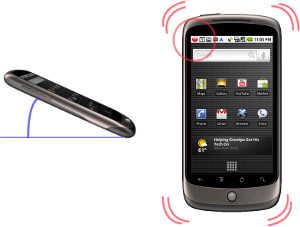
Like any good doctor (or entrepreneur), Fishman has a way to treat his diagnosis. He's helped to design an app currently available on the Android market that alerts texters when their posture is putting them at risk of Text Neck.

"The app works off of the accelerometer. It senses the pitch angle of the phone and alerts the user," explains Fishman. "In order for you to actually see the screen comfortably you have to hold it with proper posture otherwise it alerts you with the indicator turning red, and an optional vibration and beep."

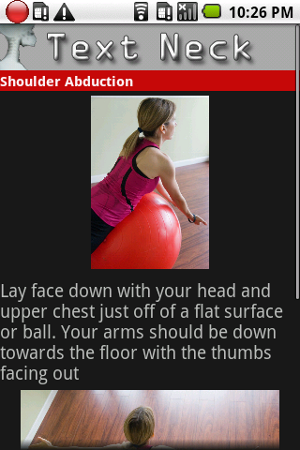
The app also includes exercises to combat the onset of Text Neck.

"The exercises are designed and have been shown (to) increase the strength and endurance of the postural muscles that are affected by this text neck presentation," says Fishman.

Preliminary medical research in recent years seems to support the notion of a connection between texting and neck pain, but many doctors in the field say more research is required.

is available for a one-time fee of $2.99.

Images courtesy Neurotilt.
Dani AI

Generated

Brief, up-to-date context and practical steps

The term "text neck" captures a common posture: head tilted forward while looking at a phone. Definitions and the strength of the link to long‑term structural damage vary across the literature — recent reviews note inconsistent definitions and mixed evidence. At the same time, larger pooled studies show smartphone overuse is associated with higher odds of neck pain, so treating the behaviour as a modifiable risk makes sense. Defining text neck: a scoping review (Eur Spine J) and a systematic review/meta‑analysis on smartphone overuse summarize this nuance. (pubmed.ncbi.nlm.nih.gov)

Actionable prevention you can apply right away

  • Raise the device: bring the screen closer to eye level rather than flexing the neck down.
  • Change how you hold and use the phone: use two hands, rest elbows, use a stand or speaker/earbuds for calls, or switch to voice‑to‑text for longer messages.
  • Build micro‑habits: set a timer to look up and move every 20–30 minutes, do short chin‑tuck and scapular‑squeeze sets (10–15 seconds, repeat several times), and alternate tasks so the neck isn’t held in one position too long.
  • Combine ergonomic fixes with movement: posture + regular breaks + gentle strengthening/stretching is more reliable than any single tool. Trusted clinical pages give concise home rules and red flags for when to seek care. NHS: Neck pain and Mayo Clinic: Neck pain summarize simple prevention and when to see a clinician. (nhs.uk)

Where hands‑on habit training fits

As points out, approaches that retrain movement habits can be durable. Techniques like the Alexander Technique have randomized‑trial evidence for long‑term benefit in chronic spinal pain when combined with exercise, so consider habit‑retraining (Alexander, physiotherapy, or supervised exercise) if self‑care doesn’t help. See the ATEAM trial summary for details. (pubmed.ncbi.nlm.nih.gov)

Practical note about posture apps

Apps and posture alarms (like those noted earlier in the thread) can raise awareness, but they work best as one part of a plan. Expect some fiddling with sensitivity, watch battery use and notifications, and pair an alerting app with the exercise and behaviour changes above rather than relying on alerts alone. If pain is severe, progressive, or accompanied by numbness, weakness, fever, or loss of bladder/bowel control, seek prompt medical evaluation. (mayoclinic.org)

salimmohammad 0 Newbie Poster

hi dearest how r u ?

markjaye 0 Newbie Poster

Another way to approach 'text neck' is to think of it as being similar to 'blackberry neck' or 'computer neck' or any other neck. "Forward head posture' is the same; they're all ways we poke our necks out and down. The Alexander Technique deals with people's necks from the first session. It can teach you less harmful ways to text, use the computer or any other everyday action. The results are permanent because you develop new habits.
Mark Josefsberg
http://www.MarkJosefsberg.com

Be a part of the DaniWeb community

We're a friendly, industry-focused community of developers, IT pros, digital marketers, and technology enthusiasts meeting, networking, learning, and sharing knowledge.