Barnes and Noble launches eTextbook application

Emily Banks 0 Tallied Votes 659 Views Share

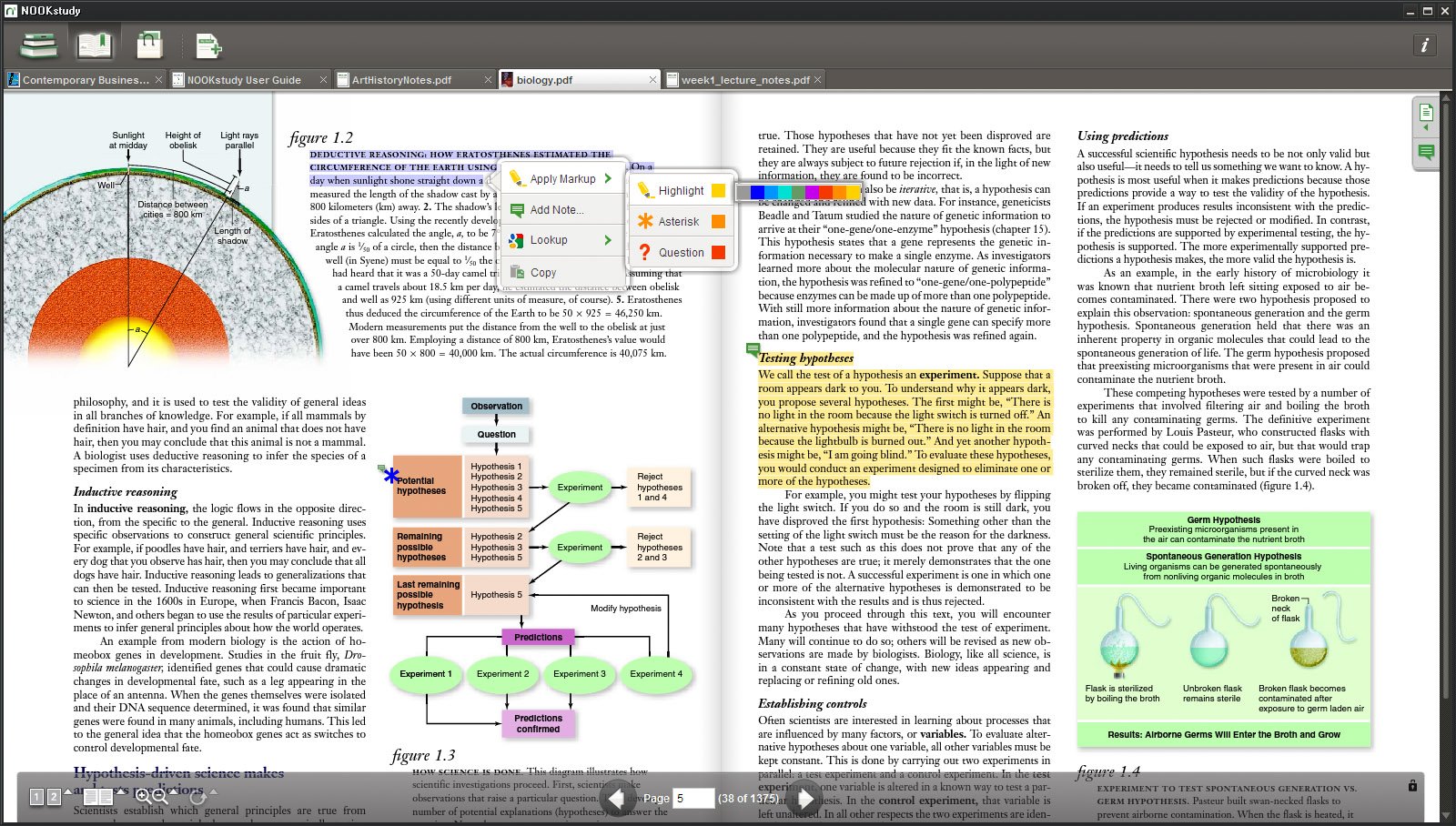
Textbooks are among the top expenses for college students. Today Barnes and Noble launched its app to eliminate at least some of the production costs for textbooks. The company released NOOKstudy, a Web-based e-Textbook application that can bring students a 50 percent savings, according to an announcement today.

“We’re thrilled to roll out our revolutionary NOOKstudy application to provide higher education students with unprecedented freedom to access their eTextbooks and other resources on their PC or Mac anytime and anywhere to make it easy to study smarter," said Tracey Weber, executive vice president of textbooks and digital education.

The computing device allows students to to manage texts, class materials and notes on their computer in the one application. Students have instant access to download texts; they'll save time and money and can more easily organize and categorize their information and research, according to today's press release.

The application is free to download at NOOKstudy.com and will also be available this fall in stores.

“As leaders in the college bookselling arena, we aim to deliver college students the greatest choice, flexibility, savings and value when it comes to their textbook, reading and study needs,” Weber said. “With new, used, rental and digital textbooks, we offer students across the country the ability to choose the formats that are best for them – whether they prefer digital, physical, renting or owning.”

Barnes and Noble isn't the first company to make textbooks available electronically, but it does differentiate itself with NOOKstudy, because it doesn't require a new device like a Kindle. In fact, the program doesn't run on Barnes and Noble's own e-book reader Nook, because it doesn't allow for enough screen space for image-heavy textbooks.

Pilot programs and studies where colleges gave students a Kindle in place of textbooks have for the most part proven unsuccessful. Among the complaints are that the Kindle is another added expense for students, especially when they still have to purchase the e-book.

Barnes and Noble's application can be downloaded on up to six devices, but purchased texts can be available on no more than two.
Dani AI

Generated

reported the original NOOKstudy rollout; a practical update from the years since: vendor platforms and business models change, and that can break access or force migrations. Barnes & Noble later moved away from the NOOKstudy/Yuzu approach and restructured its e-textbook strategy, outsourcing much of its digital textbook delivery to third parties. (investor.bned.com)
(Barnes & Noble Education press release: https://investor.bned.com/investor-relations/news-and-events/news/press-release-details/2016/Barnes--Noble-Education-Reports-Fiscal-2016-Third-Quarter-Financial-Results/default.aspx)

On the resale question from : mainstream e-book stores generally grant a license, not ownership, for digital copies — Amazon’s Kindle terms explicitly say content is “licensed, not sold.” That licensing model, coupled with U.S. court precedent, means there is no reliable legal secondary market for most purchased digital files; courts have rejected ReDigi-style resale schemes because transfers of digital files typically require creating new copies. (wired.com)
(see Wired on Kindle licensing: https://www.wired.com/2012/10/amazons-remote-wipe-of-customers-kindle-highlights-perils-of-drm/; legal discussion of Capitol Records v. ReDigi: https://jolt.law.harvard.edu/digest/s-d-n-y-holds-that-the-first-sale-doctrine-does-not-permit-the-resale-of-a-digital-music-file)

Practical alternatives and lower-cost strategies that avoid the resale problem: buy or rent used physical copies, compare rental/e-text platforms (marketplaces and campus stores), and adopt Open Educational Resources (OER) where available — OpenStax is a growing, peer-reviewed source of free college textbooks. (news.rice.edu)
(OpenStax overview: https://news.rice.edu/news/2020/openstax-vastly-expand-open-education-library-support-national-foundations)

A short checklist for buying digital textbooks (to reduce future headaches): confirm whether the file is actually a licensed copy or DRM-free; check printing/export/annotation-export options; verify device or account limits and vendor sunset/migration policies; prefer DRM-free EPUB/PDF or OER when possible; and keep receipts plus any local copies that the vendor permits. Vendor-side changes (for example, removal of direct download options) have happened in the past, so portability and backup matter. (the-digital-reader.com)
(The Digital Reader on B&N download/remove changes: https://the-digital-reader.com/bn-says-took-away-download-option-security-measure-heres-get-around/)

This post complements the original coverage by focusing on long-term access, resale realities, and practical steps students can use to limit cost and risk.

AuburnMathTutor 37 Junior Poster

especially when they still have to purchase the e-book.

Plus, is it possible to resell books on your Kindle to the Kindle store? I always liked taking books I didn't want anymore (mostly nontechnical, but not all) and getting a few twenties. Beer money, anyone?

Be a part of the DaniWeb community

We're a friendly, industry-focused community of developers, IT pros, digital marketers, and technology enthusiasts meeting, networking, learning, and sharing knowledge.