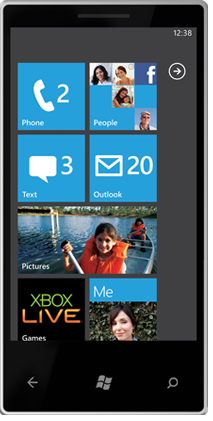
Imagine taking your favorite games with you wherever you wanted and being able to play whenever you wanted. That is the selling point behind Microsoft's latest move today at in Germany where they announced a massive line up of game titles to be released on Windows Phone 7 which is set to hit the market just in time for the Christmas shopping season this year.
Major game creators including industry giants like , Gameloft , and Namco Bandai have all joined the project to offer a large selection for users to choose from. The line up is packed with popular game titles including “Assassinssss Creed”, “Fast and Furious”,“Halo Waypoint”, “Castlevania”, “Guitar Hero 5”, and “Starwars: Battle for Hoth”. The line up will also offer an array of casual and classic gaming favorites such as “Bejeweled LIVE”, “Bubble Town 2”, and “Frogger” so there will be something for almost every type of gamer out there; however, Microsoft is hoping to make a major splash with this release to set a new industry standard for mobile gaming by offering more than a large selection of titles. ( .)
Windows Phone 7 will also include the same type of gaming features that players have come to expect on Xbox LIVE like a multiplayer feature that will allow you to connect to other Windows Phone 7 users and messaging capability for easy communication with fellow players. You will also have access to your Xbox LIVE avatars and be able to connect to your profile and friend's list while on the go. Another ambitious goal for the mobile gaming on Windows Phone 7 is the ability to track your achievements across platforms when you are playing one of the included titles, so if you break that Bejeweled record while on your lunch break it will still up date the leaderboard and your account just as if you were playing on your console at home, and visa versa.
Windows Phone 7, an operating system for mobile phones, was first announced in February of 2010 at the Mobile World Congress in Barcelona and plans to lure customers in with a familiar interface, feature built platform, and mobile gaming experience that they hope will help them to take the mobile world by storm and over shadow the competition and not a moment to soon; with the battle between Microsoft and Google raging on, this move could be a big asset in Microsoft's arsenal.[youtube]MdDAeyy1H0A[/youtube]