Yandex is one of the leading Internet portals in Russia, and yes they do still use that terminology instead of search engine. The name itself, apparently, stands for Yet Another Indexer which is kind of apt as the company has just published the results of Yet Another iPad Survey. However, this one is a little different to your run of the mill iPad research as it is both specific to user behaviour and more precisely specific to Russian user behaviour. As such it gives us an insight into how others around the world are using their tablet devices.
For a start, we learn that iPad use in Russia has rocketed more than six times over from 2011 to 2012 with more than 700,000 people now using the Apple tablet. To put that into some context it equates to just about 1% of all Russian Internet users, so not amazing but a decent enough slice of the Internet access pie none the less considering that the iPad only went on sale officially in Russia at the end of 2010. The growth rate of iPad ownership in Russia has far outpaced both mobiles which grew by 2.5 times and PC's which grew by 1.4 times in the same period.
The really surprising statistic to come out of this research, at least as far as iPad ownership is concerned, was that it revealed over half of iPad owners in Russia come from the Moscow region which suggests that the country's capital remains the centre of wealth creation and aspirational consumerism.
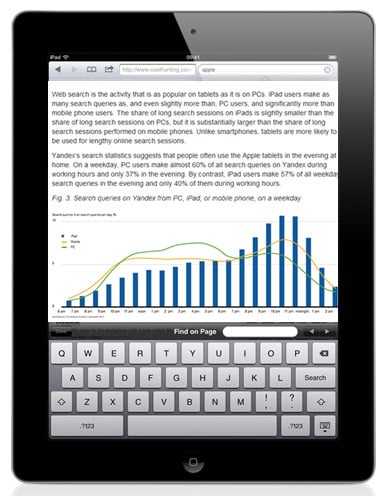
Equally interesting is the fact that, as far as Russian iPad users are concerned at any rate, the iPad usage patterns are more closely aligned to those of the average PC user than the average smartphone user. Of course, this being an Internet search company the survey is based upon online use and in relation to browsing the web the evidence suggests that a tablet is far better suited for this purpose than a smartphone. No surprises there then. When it comes to actually searching the Internet, this activity is just as popular on the iPad as on the PC. In fact, iPad users were shown not only to make as many search queries as PC users but actually slightly more. Smartphone searches lag way behind both.
These iPad search queries are most often made during the evening and at home, with some 57% made during this time and only 40% during working hours. PC users showed an almost entirely reversed search pattern with 60% made during working hours and 37% in the evening. Weekends are also prime search time for iPad users, with an increase in search activity of some 20% compared to a fall of 20% in PC users searching at the weekend.
So what are these Russian iPad users searching for? Well, take note all you SEO professionals looking to make inroads into the Eastern European market, the answer is primarily subjects related to both travel and the home. What they are not as interested in is gaming, entertainment and social networking apparently. As Yandex admits, this could simply be down to iPad users being more likely to search for these things using the App Store and the search functionality of some specialist apps themselves.
While there is absolutely no doubt that iPad users do frequently, in fact probably most frequently, use specialised apps they also actively use the wider web more than many people may think. The Yandex research shows that they use the web just as much as your average PC user does in fact.