Visa, Bank of America to pilot smart phone payment program

Emily Banks 1 Tallied Votes 507 Views Share

Who needs plastic in the 21st century?

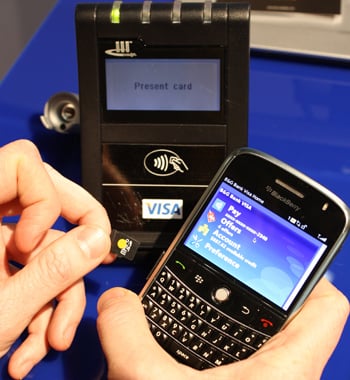
Two major U.S. banks have confirmed that they will later this year be launching joint test programs with Visa to let customers make in-store purchases with their smart phones. Reuters reported Thursday night that both Bank of America and U.S. Bancorp will be piloting programs this fall; Bank of America's program will begin next month in the New York area and U.S. Bancorp's will begin in October.

Visa had announced in February it planned to research mobile contact-less payment methods, but at the time, the company didn't reveal which banks it would be working with.

With the growing use of smart phones and banking services on the phones, it only seems logical that payment via smart phone should follow and Bank of America's head of electronic commerce told Reuters just that.

"We see this as a critical capability given the increasing acceptance and adoption of bank services on the phone," said Laurie Readhead.

So how does the program work? Small chips that emit radio signals are installed into the phone. Customers wave the phone near point-of-sale devices in store to complete a purchase.

The Bank of America pilot will be limited to a group of New York-area employees and customers and is set to expire at the end of the year.

Reuters also managed to confirm that major U.S. cell phone companies were working with at least one credit card company to achieve a similar goal. AT&T, T-mobile and Verizon, along with Discover Financial Services, are working on a mobile payment services joint venture, according to Reuters.

Photo by Tom Purves on Flickr. Used under Creative Commons license.
leakeller916 commented: learn More: https://cardwisechoice.com/ +0

Dani AI

Generated

— That pilot was an early example of the contactless direction mobile payments took. The practical stack that matters is twofold: a short‑range NFC link to the terminal and an EMV Contactless payment application that negotiates the payment, cryptograms, and risk rules — those two pieces are the technical backbone for tap‑to‑pay deployments. (nfc-forum.org)

Security and provisioning changed a lot after those first pilots. Modern mobile wallets avoid storing full PANs on the device by using issuer‑ or network‑issued tokens (device account numbers / network tokens) plus per‑transaction cryptograms. Tokens are stored or referenced via a Secure Element on some platforms, while other platforms support Host Card Emulation (HCE) so the wallet can emulate a card in software; both approaches rely on token services and dynamic cryptography rather than fixed card numbers. (support.apple.com)

A short, practical checklist that reflects what breaks in real shops: the merchant terminal must support contactless/EMV contactless (look for the contactless mark); the phone’s wallet needs a provisioned token and to be set as the active payment method; device authentication (biometric/passcode) must be available and used. Common failure causes are NFC turned off, the wallet not provisioned or not set as default, or an older terminal/kernel that doesn’t accept the wallet’s payment AID. Testing across terminal vendors and EMV contactless kernels avoids most surprises. (emvco.com)

For integrators: design around token provisioning and lifecycle (enrollment, revocation, re‑provisioning), decide Secure Element vs HCE tradeoffs early, and validate against EMV contactless test suites and tokenization services. That approach keeps deployments secure, minimizes friction at checkout, and makes the old “who needs plastic?” idea actually practical. (emvco.com)

Be a part of the DaniWeb community

We're a friendly, industry-focused community of developers, IT pros, digital marketers, and technology enthusiasts meeting, networking, learning, and sharing knowledge.