Stanford developers present the smart camera phone

Emily Banks 0 Tallied Votes 579 Views Share

First came the smart phone. Next comes the smart camera phone.

Thanks to researchers at Stanford University , your smart phone's camera might eventually have a plethora of its own apps that are more advanced than even the iPhone's limited inventory of camera apps.

"Camera manufacturers used to ignore phones because they could say the image quality was too poor to worry about," Paul Worthington, an analyst from Future Image, told . "Today it is smart cameras versus dumb cameras."

The Stanford researchers have created computational photography software for the Nokia N900 phone that gives users added control of the camera and makes apps possible, according to Technology Review. For instance, some of the apps they've created open up new possibilities for photography, like being able to automatically stitch together panoramic images or capture both light and dark areas of an image, by using different exposures for different parts of a scee.

The software was presented this week at the SIGGRAPH computer graphics conference.

"If other people in the mobile space start to experiment with these ideas, and users find that useful or cool, we will see similar apps in the biggest mobile app stores," said Marc Levoy, one of the Stanford researchers who shared the software at the conference. "That will put pressure on the camera industry to open up to allow similar innovation using their platforms."

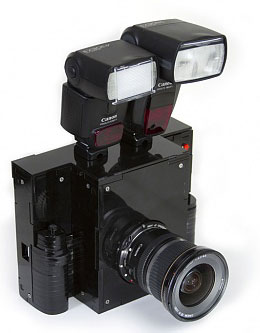
The researchers also unveiled their "Frankencamera," an experimental "computational camera," they built from scratch, according to TechnologyReview. The Frankencamera surpasses the limitations on current cellphones, but might be an ideal benchmark for camera phones in the future. The prototype runs Linux, is fully programable, connects to the Internet, accommodates SLR lenses and is built from off-the-shelf parts.

"It's also ugly - hence the name," the developers wrote on Stanford's Web site .

The developers publicly released the for the Nokia N900 camera phone on July 21.

Photo by Stanford University .
Dani AI

Generated

Good summary by — the bigger point is that imaging intelligence is shifting from fixed hardware into software stacks. That lets modest optics do clever things, but it also moves the hard work onto capture control, low-level sensor access, and real‑time processing. The payoff is flexible features; the tradeoffs are platform and power constraints.

A short practical checklist for developers and experimenters:

  • Prefer raw sensor data over JPEG whenever the platform permits; raw keeps linear range and avoids baked‑in ISP decisions.
  • Record precise frame timestamps and per‑frame metadata (exposure, ISO, focus, lens geometry) to enable robust alignment and fusion.
  • Lock or control AF/AWB during multi‑frame captures to reduce interframe variation; when motion exists, use robust alignment (feature matching or dense flow) before merging.
  • Separate linear pipeline steps (demosaic, denoise) from perceptual steps (tone mapping, sharpening) so algorithms operate on well‑conditioned data.

Prototype algorithms on the desktop first with libraries such as OpenCV and LibRaw, iterate with objective metrics (SSIM, PSNR) plus visual checks, then port performance‑critical paths as native modules or GPU shaders. On device, plan for incremental previews and background processing: mobile CPUs, RAM, battery, and thermal limits make full‑resolution, real‑time processing challenging without careful optimization.

Two practical cautions: vendor drivers and platform APIs are often the real bottleneck — insufficient driver access can force awkward workarounds — and privacy/licensing concerns rise when storing metadata or shipping code that depends on proprietary components. Thanks to for highlighting the research and to for keeping the thread active; discussion like this helps bridge lab ideas and real mobile implementations.

Imogenmorgan 0 Newbie Poster

Thanks for sharing Information about smart camera.

Be a part of the DaniWeb community

We're a friendly, industry-focused community of developers, IT pros, digital marketers, and technology enthusiasts meeting, networking, learning, and sharing knowledge.