Hey guys,

So i've been hearing all this hype about the new Ubunut 8.04 and i wanted to try it out. So i've treid the Live CD and i like it, very much. Now i want to dual boot XP and Hardy Heron.

Right so i need to resize my partition, so i've looked on the computer management in XP and found this:
[IMG]http://i170.photobucket.com/albums/u266/Moreton02/untitled.jpg[/IMG]
Now what the hell does this mean? I've got 4 partitions?
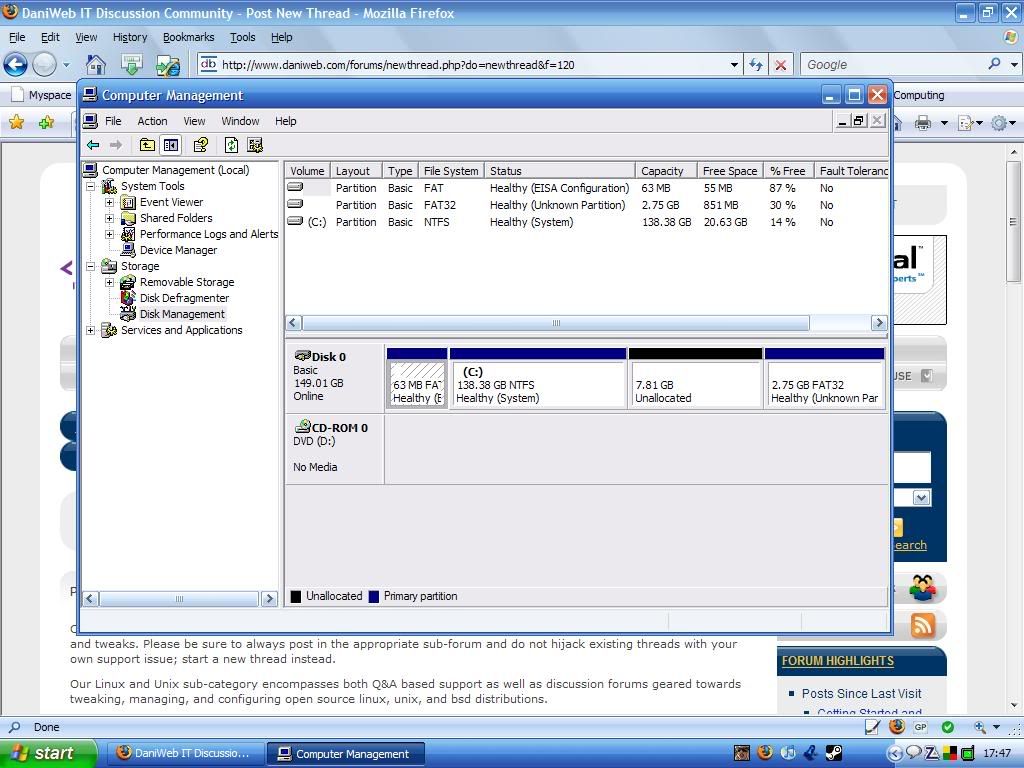
What is the 2.75 Gb of space that is unknown, how do i correct this?

Since i'm guessing that you can access all your XP files from ubuntu, i only need to create a partition big enough for the actual Ubuntu OS, and upgrades, not any files.

I've looked at the manual on the ubuntu website, and it explains that you can resize the existing partition, but i think i need to get the existing partition to use up this extra space, the 7.81Gb of unallocated space, and the 2.75 Gb of unknown space.

Dani AI

Generated

A concise, practical checklist and explanation to complement the replies from , and .

First priorities: preserve the vendor recovery capability and back everything up. is right to flag hidden OEM areas — altering the partition table can break the one‑button restore some laptops use. Create the manufacturer’s recovery discs (or confirm a working XP install CD) and copy personal data to external media before touching partitions.

How to identify the mystery entries: boot an Ubuntu Live session and inspect the disk rather than guessing from the XP GUI. That will show filesystem types, labels and flags and make clear which volume is a recovery area, which is unallocated, and which is the active Windows volume. Note also that the common MBR layout only holds up to four primary entries; one primary can be an extended container for many logical partitions — that often explains confusing lists of volumes.

Safe sequence to resize and install:

  • From Windows run error checking and a defragment, then reboot to ensure the filesystem is consistent.
  • Boot the Live CD and use GParted to examine and then shrink the NTFS volume into contiguous free space. Apply changes and confirm Windows still boots before proceeding.
  • Run the Ubuntu installer and choose manual partitioning if precise control is needed: create an ext4 root (and optional separate /home) plus a swap partition sized according to RAM/hibernation needs. Automatic use-of-free-space options can work, but manual gives more control when OEM partitions exist.

Quick commands to inspect from a Live session:

sudo fdisk -l
sudo blkid
gparted

Final cautions: keep recovery media and the Windows CD ready. If the bootloader needs restoring, the Windows recovery console can fix the MBR. Manual inspection and deliberate, incremental steps are the safest approach when OEM recovery areas and an unfamiliar partition map are involved.

Recommended Answers

All 4 Replies

DONT install ubuntu. Im guessing that partition is a hidden one which your manufacturer put there (dell, hp and ibm do this). from this partition you can reinstall windows if it ever gets corrupted etc... by pushing a button on bootup. MAny manufacturers include ONLY this and NO recovery cd-s, meaning that once you get rid of it, you are screwed when you need to reinstall windows. If this is the case, ONLY install after ensuring that you have valid, legal, working O/S install media in the form of something like CDs. Resizing / otherwise modifying the partition table generally breaks this feature, so if you need it, do not proceed.

I've got a working XP CD that came with my computer, anyway would that space really need to be as large as 7Gb or 2Gb?

I think that the small partition, the 63Mb one is an important one, but no the bigger ones.

What do you reckon, do you think that i should try and get these random partitions to be added to the main XP one?

When uncompressed, an xp system is about 3.5gb , then you have all the manufacturers own crap added onto it.

well, if you have 7.81 GB of unallocated, ubuntu should see it and, in the installer, it should have a radio button that says "use largest amount of continuous free space" or something like that, it means the unallocated space. i agree with jbennet in that you shouldn't mess with the 2.75 GB of unknown space, 7 GB should be plenty for ubuntu, and if you run out of space, just save some stuff on your xp partition that aren't vital to the system.

Be a part of the DaniWeb community

We're a friendly, industry-focused community of developers, IT pros, digital marketers, and technology enthusiasts meeting, networking, learning, and sharing knowledge.