Greetings-
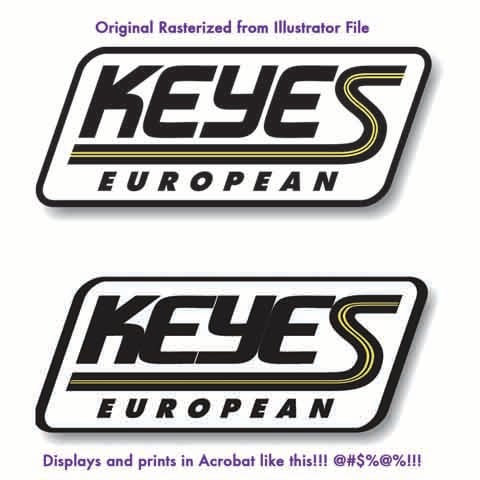
I have been stumped trying to figure this one out so I am giving you a shot. Sometimes when I place an Illustrator file into Quark 6.5 and then export it as a PDF file, the logo will spread on me. Basically, the Illustrator file is a logo of a local car dealership, that is all paths. On some of the paths there is a stroke applied but there is plenty of white space between the letters. However when I view it in Acrobat, the letters appear to have spread to the point of touching each other. I can think of no reason for this.

Another issue I have encountered from time to time with another logo, is that sometimes the paths will look as if the rounded letters have been created with a series of small straight lines. In the world of imagesetting it would be called the flatness value, but I don't understand why it's happening. I am quite savvy on the mac and have been the troubleshooting guy myself for many years, but I can't get to the bottom of this. I have discovered a workaround to this problem by going to the Advanced button in the Print dialog box and then in the next window clicking on "Print as Image" checkbox and that has ended the problem. I'd still like to know why it's doing it though. However, the first issue is more pressing to me as I have a deadline looming using the first logo I spoke of.
I am working on a G5 dual 2Ghz mac, running Panther 10.3.9. I am using the CS suite (not CS2) along with QX6.5
Thanks in advance for any light you can shed on this for me.
Best regards,
David Aaron
Dani AI

Generated

Short summary and practical follow-ups based on ’s report and ’s print-driver observation.

The behaviour described — vector artwork appearing to “spread” or curves turning into faceted straight segments — points to something in the PDF/print pipeline doing rasterization or poorly approximating Bézier curves. This can happen at several places (export from the application, Quark’s PDF/print path, transparency flattening, or the RIP/printer), so the next steps are about isolating where the change is introduced and applying a predictable fix.

Checklist to diagnose (fast, in order):

  • Zoom the PDF very large (2000–6400%) in Acrobat Pro. Smooth edges = vector; visible pixels = rasterized earlier.
  • Open the same PDF in Illustrator. If paths are still selectable as paths, the file stayed vector; if it’s a placed image, it was rasterized.
  • In the original Illustrator file use Outline view to look for duplicate, overlapping fills, stray objects, or compound-path oddities that can create “fill creep” when flattened.
  • Check for any transparency, masks, complex strokes, brushes or effects in the logo; these are the usual triggers for unexpected rasterization.

Practical fixes to try (non-destructive order):

  • Export a PDF directly from Illustrator with a PDF level that preserves live vectors (avoid forcing down-conversion that flattens everything).
  • If a particular RIP or printer is the target, test the PDF on another machine/printer first to confirm whether the problem is device-specific.
  • Where a quick, safe fix is needed for a deadline: create a single high-resolution vector-preserving PDF from the original art or, as a last resort, a very high-res placed TIFF for that job — but keep a true-vector master for future use.
  • For prepress jobs, run Acrobat Pro’s Preflight/inspection tools (or open in Illustrator) to see exactly which objects were rasterized and at what resolution.

Note: this is not a display-only artifact — if Acrobat shows pixelization when zoomed way in or Illustrator shows placed images, the flatten/raster step occurred before/at PDF creation or in the RIP. The cleanest long-term solution is to find which step in the workflow forces rasterization and change that export/flattening setting or simplify the offending artwork so the pipeline can keep it as vector.

Davedesign

I had the same problem. Here is how I resolved the issue.
In your print dialog box click on “ADVANCED”.
Set the Raster / Vector Balance to 100.
(This has corrected another problem that I was having with jagged type on my final print out.)
Below that you will find an area containing three options.

Convert all text to outline
Convert all strokes to outline
Clip Complex Regions

NOT CHECKING the first two should solve your problem.
The third is hit or miss. This option ensures boundaries between vector and rasterized objects fall along object path. However, this may contradict flattened and vector objects. It may ( as I found in my case ) be too complex for the image setter / printer to handle.
Hope this helped
Greg

Be a part of the DaniWeb community

We're a friendly, industry-focused community of developers, IT pros, digital marketers, and technology enthusiasts meeting, networking, learning, and sharing knowledge.