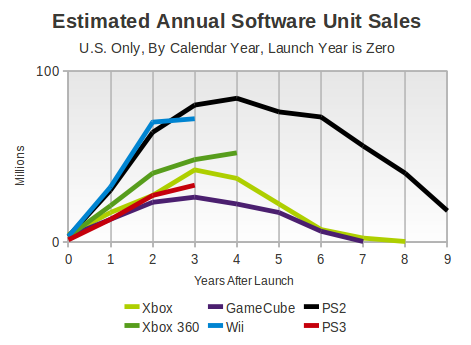
At a recent Q&A session in front of investors at E3, Nintendo of America CEO Reggie Fils-Aime adamantly defended the Wii console’s pace to break the record-setting game sale trends of the Playstation 2, claiming that his console is at the “high watermark” of its existence, with software sales numbers topping that of the PlayStation 2, Playstation 3, and Xbox 360 in the current market. Matt Matthews, analyst for Gamasutra, has compiled a data outlook suggesting otherwise, contending that the Wii console has recently reached its software peak.
"[Wii software] appears to have hit a plateau in 2009 with sales inching up only marginally, and falling behind the estimated trajectory of PlayStation 2 software sales."
According to a May 2010 report released by The NPD Group, one of North America’s leading market research companies, Wii hardware sales have increased 44% since May 2009, while software sales are down 29%. Michael Pachter, gaming analyst at Wedbush Morgan Securities in Los Angeles, suggests that at in its current state of decline, we may see an “unprecedented” showing from the console in 2010, with the Wii only moving two software titles per owned console. That’s not the good type of unprecedented.
“Wii software sales were down 29 per cent year-over-year…while PS3 software sales were up 58 per cent and Xbox 360 software sales were up 29 per cent. We think this is remarkable, given growth in the Wii hardware installed base of 44 per cent and growth in the DS installed base of 33 per cent over the last 12 months. In our view, this indicates that Nintendo’s customers either are not finding enough software to satisfy their needs, or need less software than the typical Sony or Microsoft customer.” It’s hard imagining just how or why so many third-party developers fail to deliver a consumable asset to the 70.93 million console owners worldwide when considering the simplicity of the Wii’s top three titles: Wii Sports (63.46 million), Wii Play w/ Wii Remote (27.38), and Wii Fit w/ Wii Balance Board (22.61 million). While the Wii unit sales have clearly shown a massive potential market eager for titles, the third-party developers are failing to cater to them.
Nintendo’s AAA franchises—Super Mario, Mario Kart, Super Smash Bros., Mario Party—have had to take the majority of the Wii’s weight on their shoulders throughout its life span, with first-party titles from Nintendo accounting for 32% of software sales alone. Notice a trend with the aforementioned titles? Owners left to sift through a sea of mediocrity in an attempt to find their next game purchase are left with the smiling brand recognition of everyone’s favorite Guido plumber when ultimately the promise of playing virtual air hockey or pool fails them like the miserable graphics and controls of another poorly produced, poorly executed title looking to cash in on the Wii’s interactivity.
The once highly-touted end all, be all to the holiday season is hitting its twilight in only its third year of existence, which will leave many owner’s stranded with inevitable buyer’s remorse in the years to follow. While its system sales have always been nothing short of phenomenal, a failing supply and demand of redeemable titles are crippling the Wii’s longevity, as well as expectations of what are to come for the console. Instead of building a console around interactivity, they should of built interactivity around the console.Graph courtesy of Gamasutra