Connected TVs Become Mainstream

Updated VanessaRyan 0 Tallied Votes 287 Views Share

The TV market is entering a new stage, as Internet connected TVs shipments surge. According to the latest DisplaySearch Quarterly TV Design and Features Report , Internet connectivity has emerged as a key feature in TVs this year.

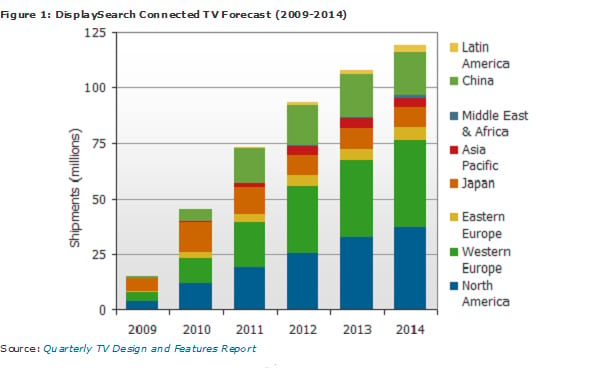
This survey of 2010 product ranges from leading brands reveals that 55% of TV models available across Japan, North America, Europe, China and India have Digital Living Network Alliance (DLNA) capability. This is expected to convert to over 45 million connected TV sets, 19% of flat panel TV shipments in 2010. The connected segment is forecasted to reach 119 million units in 2014, accounting for 42% of all TVs shipped worldwide.

Paul Gray, Director of TV Electronics Research at DisplaySearch states DLNA has been a solution in search of a problem for some time, but now with the surge in media streaming, it has found its place. Media streaming will create business opportunities for TV set makers, broadcasters and retailers. And as a result, consumers will have new viewing choices.

Additionally, the research covers the progress made in the development of energy efficient TVs, as well as enabling technologies such as LED backlights, which are forecast to be in over 80% of LCD TVs shipped in 2014. Its analysis of the latest energy regulations notes that while California is a leader in energy standards, with its 2013 California Energy Commission standard considered by some to ambitious even last year, the shift in technology and increased focus on energy has allowed some TV sets to use only half the power necessary for compliance.

Other aspects of the report includes details of key featuring of new 3D models launched by TV makers and forecasting for MPEG-4 decoding and the digital broadcast environment around the world.
Dani AI

Generated

As noted, "connected" covers several different things: on-TV apps, local-network file streaming, and platform-level services. For local media sharing the industry long relied on DLNA — a set of interoperability guidelines (built on UPnP) that lets a media server or NAS announce and serve photos, music and video to DLNA-capable players on the same home network. DLNA is convenient for simple file playback but it doesn't handle DRM-protected subscription streams or guarantee app availability. (en.wikipedia.org)

If the plan is to watch your own files, use a small home media server rather than depending on whatever codec list a TV ships with. Plex offers broad client support and automatic library management; Jellyfin is a fully open-source alternative you can self-host. Practical tips: prefer wired Ethernet for high-bitrate (4K) playback, confirm whether the TV can decode your containers/codecs or let the server transcode on the fly, and keep the TV’s firmware current. When a TV can't see your server, check that both devices are on the same subnet, disable AP/guest isolation on the router, allow UPnP/SSDP discovery through local firewalls, and verify the server has DLNA/UPnP enabled. (support.plex.tv)

Security and privacy are real concerns with smart TVs. Regulators have acted when manufacturers collected viewing data without clear consent (notably the FTC action versus a major maker), so during setup opt out of "viewing analytics"/ACR, disable voice/mic features you don't use, and consider isolating TVs on a guest VLAN or using an external, privacy-respecting streaming stick under your control. Keep an eye on firmware updates and on the TV’s privacy/settings screens — they matter more than the glossy feature list. (ftc.gov)

Be a part of the DaniWeb community

We're a friendly, industry-focused community of developers, IT pros, digital marketers, and technology enthusiasts meeting, networking, learning, and sharing knowledge.