Do you suffer from IT Admin stress? You are not alone...

happygeek 1 Tallied Votes 341 Views Share

An incredible 69% of IT Administrators are so stressed at work that they have seriously considered changing career as a result, according to a new survey from GFI Software. The 'IT Admin Stress Survey' also revealed that 34% of IT Administrators will work overtime equivalent to an additional 12 weeks each year, and that's without any additional pay for their troubles.
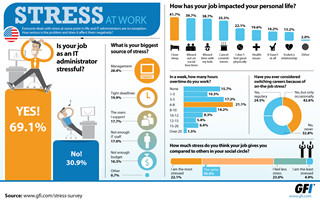
adminstress Asking 201 UK-based IT Administrators working at businesses of between 10 and 500 employees, the survey found that 66% of those questioned considered their jobs just as stressful, or more stressful, when compared to others in their immediate social circle. The amount of stress would seem to vary according to the size of the company concerned, with 56% claiming to be stressed where between 10 and 49 staff are employed but 84% where that figure is between 50 and 99.

Perhaps unsurprisingly, the main causes of stress for the IT Admin were considered to be management issues (36%), user issues (21%) and having to meet tight deadlines (15%). What was more surprising was the sheer scale of overtime being put in by IT Admins, with many routinely working beyond the 48 hour working week as laid down in law by the EU Working Time Directive and 34% admitting that they worked for 10 hours or more in overtime during the average week. These long working patterns mean that 42% had missed social functions, 36% missed spending time with their children, 29% suffered from health-related issues such as high blood pressure and 20% experienced strain which had ended a relationship with a friend or partner.

Phil Bousfield, general manager of GFI Software’s Infrastructure Business Unit says that "SMBs need to take these findings as a wake-up call, and ensure that IT staff are supported, productive and armed with the tools they need to be successful. Doing so will deliver business value and help IT Admins have a better work-life balance.”

Dani AI

Generated

This thread captures a very common problem in operations work: endless interruptions, overtime and the mental load that comes from being the person who “fixes everything.” ’s post and the replies from , and illustrate the same pattern — work that constantly expands until it crowds out life. Burnout is now recognized by the World Health Organization as an occupational phenomenon, and public health work has linked very long working hours to serious cardiovascular risks. (WHO on burn‑out, WHO/ILO on long working hours).

Practical team-level fixes that actually work: treat operational load as an engineering problem. Adopt a “reduce toil” goal (measure how much of the team’s time is consumed by repetitive ops work and act on it), formalize sensible on‑call rotation sizes, and invest in automation and alert tuning so people aren’t woken for noise. Google’s SRE guidance on eliminating toil is a good playbook for this. Also, managers have a legal and moral role in reducing harmful stress at work — employer guidance from regulators outlines practical steps teams can take. (Google SRE on toil, OSHA employer guidance).

Concrete, low-effort individual actions to try this week: document the single most common pager into a one‑page runbook, mute or rethreshold one noisy alert, and capture how often the same problem repeats so you can escalate it with data. Structured incident procedures and lightweight playbooks make outages faster and less chaotic; NIST’s incident response guidance and practical playbook articles show how to start small and iterate. (NIST SP 800-61 incident handling).

Start with one small win — silence a noisy alert, write one runbook, or ask for one week of protected time to automate a recurring fix. Small, documented improvements compound quickly and are the best defence against the “always‑on” treadmill.

abigel02 0 Newbie Poster

No i m not suffering..but sometimes it is hectic to maintain the balance...

Member Avatar for Member #949455
Member #949455

These long working patterns mean that 42% had missed social functions, 36% missed spending time with their children, 29% suffered from health-related issues such as high blood pressure and 20% experienced strain which had ended a relationship with a friend or partner.

Balance is hard to adjusted sometimes.

CimmerianX 197 Junior Poster

Gawd Almighty, please send me a Valium-Vicoden-Vodka-Latte while I tell this idoit to reboot for the 9th time, tail logs from the Load Balancer, Web host, and Sql host, all the while ignoring the 110 email in my inbox asking for help for their own "red-hot" deliverable of the day.

When can I finally retire and unplug?

Be a part of the DaniWeb community

We're a friendly, industry-focused community of developers, IT pros, digital marketers, and technology enthusiasts meeting, networking, learning, and sharing knowledge.