Humans Still Supreme Over Computers (For Now)

CatRambo 1 Tallied Votes 744 Views Share

Today in the ongoing battle for domination of the planet by demonstrating that sometimes humans are better at video games. The announcement came from David Baker, a biologist at the Howard Hughes Medical Institute, and Zoran Popovic and Seth Cooper, computer scientists at the University of Washington.

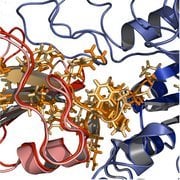
Their efforts, which were published in the journal Nature today, were part of a two year old project designed to apply brainpower from computer games to complex medical problems. One such problem was the idea of folding proteins. While scientists know the components of proteins, they have had difficulty figuring out how those components fit together. In the multiplayer online game Foldit , players demonstrated more ability to solve the problem using radical moves, risk-taking, and an ability to see the long-term picture.

Players working collaboratively develop a rich assortment of new strategies and algorithms; unlike computational approaches, they explore not only the conformational space but also the space of possible search strategies. The integration of human visual problem-solving and strategy development capabilities with traditional computational algorithms through interactive multiplayer games is a powerful new approach to solving computationally-limited scientific problems.

FoldIt was inspired by the MMORPG World of Warcraft as well as less complex online games. It's an exercise in crowdsourcing - bringinh a group's collective intelligence to bear on a specific problem or topic. Players are given a protein which they must twist and tug in order to move it to its lowest energy state. The lower the energy state, the higher the player's score. Players can compete individually or as part of a team while chatting online about the game.

The paper lists the longest set of acknowledgements in a scientific paper by including the over 57,000 humans who played FoldIt. Many FoldIt players were non-scientists; the top five solo players all had no more than a high school-level background in chemistry. Nonetheless, such players outperformed Rosetta, a program designed to predict protein structures.

[youtube]va92d9Ei1QM[/youtube]
Dani AI

Generated

An enduring takeaway for game developers and CV researchers is this: when a task is visual, ambiguous, or has many local optima, players often invent search moves and heuristics that are hard to encode up front. Treating players as sources of novel operators—rather than only as score optimizers—turns gameplay into a research pipeline.

A compact workflow to convert play into algorithmic improvements:

  1. Define the true objective and express it as robust, multi‑objective scoring so the game reward aligns with the scientific goal.
  2. Instrument every session: log full action traces, timestamps, state snapshots, undo/redo events, and chat or team actions; provide a replay export.
  3. Mine traces for motifs: cluster sequences, identify frequent macro‑moves, and visualize trajectories to spot repeatable strategies.
  4. Translate motifs into operators: parameterize common moves as proposal distributions or search operators, then test them inside an automated solver.
  5. Iterate with validation: cross‑validate on held‑out problems, add secondary domain checks, and close the loop between players and algorithms.

Troubleshooting tips:

  • If high scores produce invalid scientific results, introduce independent validators or ensemble metrics rather than a single proxy score.
  • If players find presentation artifacts to exploit, randomize visuals and add anti‑exploit tests in small batches.
  • Sustain useful contributions with progressive tutorials, clear feedback on impact, and mechanisms to surface expert play for analysis.

Thanks to for surfacing the example; the enthusiasm from and underlines how important UX and social features are for scaling participation. For lasting gains, instrumented play plus a short analysis→translate→test loop is usually the highest‑leverage design.

ﻼim 0 Junior Poster

AWESOME. =)

pavan_teja -4 Newbie Poster

Today in the ongoing battle for domination of the planet by demonstrating that sometimes humans are better at video games. The announcement came from David Baker, a biologist at the Howard Hughes Medical Institute, and Zoran Popovic and Seth Cooper, computer scientists at the University of Washington.

Their efforts, which were published in the journal Nature today, were part of a two year old project designed to apply brainpower from computer games to complex medical problems. One such problem was the idea of folding proteins. While scientists know the components of proteins, they have had difficulty figuring out how those components fit together. In the multiplayer online game Foldit , players demonstrated more ability to solve the problem using radical moves, risk-taking, and an ability to see the long-term picture.

FoldIt was inspired by the MMORPG World of Warcraft as well as less complex online games. It's an exercise in crowdsourcing - bringinh a group's collective intelligence to bear on a specific problem or topic. Players are given a protein which they must twist and tug in order to move it to its lowest energy state. The lower the energy state, the higher the player's score. Players can compete individually or as part of a team while chatting online about the game.

The paper lists the longest set of acknowledgements in a scientific paper by including the over 57,000 humans who played FoldIt. Many FoldIt players were non-scientists; the top five solo players all had no more than a high school-level background in chemistry. Nonetheless, such players outperformed Rosetta, a program designed to predict protein structures.

[youtube]va92d9Ei1QM[/youtube]

Really nice:-)

DragonReeper 0 Newbie Poster

Wow... I already like this game and I never even played it,
asfor computers being stuper than humans, everyone knows that :P

Be a part of the DaniWeb community

We're a friendly, industry-focused community of developers, IT pros, digital marketers, and technology enthusiasts meeting, networking, learning, and sharing knowledge.