Flipping iPad app could regret taking over Twitter

happygeek 0 Tallied Votes 369 Views Share

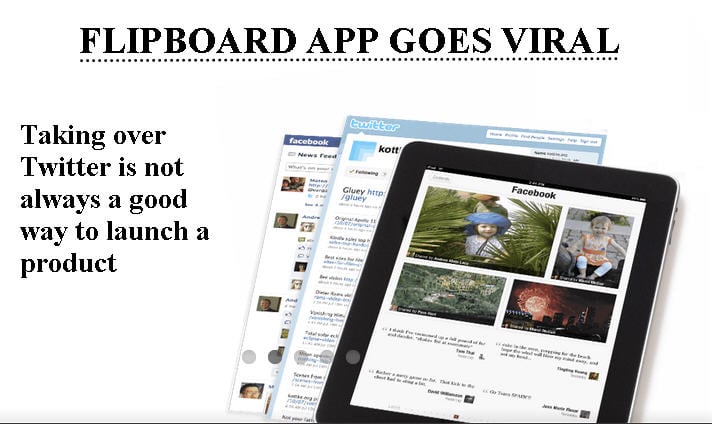
I blame Robert Scoble aka scobleizer for his 'First look at “revolutionary” social news iPad app: Flipboard' post which led to a flipping iPad app taking over Twitter for most of yesterday. Some 24 hours late, Flipboard has thankfully dropped off the trending top ten list at Twitter, although it's a fair bet some of your online friends will still be tweeting about it. So what's all the fuss about?

The fuss, my friend, comes courtesy of two simple but very powerful keywords: Twitter and iPad. Put these two together and you are almost in social media hysteria territory, and that's exactly what has happened with Flipboard: an iPad client that turns Twitter, or Facebook for that matter, into a magazine.

" , or a single brand’s Twitter account, into a Flipboard" Scoble says, and he's right of course. But this isn't a review of Flipboard, you can see Scoble demonstrate it on YouTube, it's a story about how Twitter can help make or break a product.

[youtube]M7umqKbQ3PA[/youtube]

Reports suggest that following the Twitter viral surge in interest yesterday. Many people were faced with a "Flipboard is currently over capacity" messages according to my Twitter feed. So much so that the developers of the app have now put an invitation only system into place in order to limit supply and ease the load.

One of the downsides of going viral like this is you cannot predict it, which can end up giving you bad publicity right at the point where you are keen to exploit the good stuff. Over on the official support forums for the product people are already complaining about the free app. One unhappy users writes "This is fascinating like a train wreck: awesome hype, awesome product, awesomely awful user experience due to lack of capacity".

There is also another, less welcome, downside of going viral: the inevitable Twitter backlash : comments such as "totally underwhelmed by Flipboard" and "I can't wait until Flipboard actually works. Literally. I'm deleting this app off my iPad" being prime examples.
Dani AI

Generated

This thread illustrates a familiar hazard: a single social signal can flood an app with traffic in minutes. As names it, the Slashdot Effect; highlights how hype travels fast; and ’s reaction shows users quickly lose patience. What’s missing from the early replies is a short, practical playbook teams can use when demand suddenly outstrips capacity.

  • Preflight: run realistic load tests, set concurrency SLOs and test cold starts.
  • Edge first: put static content and time-tolerant API responses behind a CDN and aggressive caching.
  • Protect the backend: enforce rate limits and queue excess requests at the edge so backends stay healthy.
  • Graceful degradation: provide cached or read-only views and skeleton UIs rather than hard failures.
  • Telemetry: tag traffic sources and set sampling to find the spike origin fast.
  • Communication: expose a status page and in-app messages so users know work is underway.
  • Postmortem: capture logs/metrics, identify bottlenecks, and update capacity plans.

A couple quick examples you can apply immediately:

# nginx rate limiting: 10 requests/sec per IP, burst 20
limit_req_zone $binary_remote_addr zone=rl:10m rate=10r/s;

server {
  location /api/ {
    limit_req zone=rl burst=20 nodelay;
    proxy_pass http://app;
  }
}
# simple overload guard (pseudo)
if (queueLength > MAX) {
  res.setHeader('Retry-After','30');
  res.status(503).send('Service busy, try again later');
}

Design for the moment you get famous: minimize single points of failure, make meaningful parts of the app usable under load, and be transparent with users. That combination protects reputation and turns a scary spike into actionable learning.

Member Avatar for Member #949455
Member #949455

There is also another, less welcome, downside of going viral: the inevitable Twitter backlash : comments such as "totally underwhelmed by Flipboard" and "I can't wait until Flipboard actually works. Literally. I'm deleting this app off my iPad" being prime examples.

I like Flipboard. I don't like twitter. But the app is not as bad. I read magazines and times on it before. Regarding about twitter, it's a bad idea.

klemmerj 0 Newbie Poster

It's called the "Slashdot Effect." Every company intending on using social media (in any form!) needs to research this phenomenon, understand how it works and have a plan for how they're going to deal with it.

Be a part of the DaniWeb community

We're a friendly, industry-focused community of developers, IT pros, digital marketers, and technology enthusiasts meeting, networking, learning, and sharing knowledge.