NVIDIA Loses Market Share, Announces New Quadro Cards

PCBrown 1 Tallied Votes 305 Views Share

ATI Takes the Lead

After a long stretch of dominance, NVIDIA has fallen behind ATI in discrete GPU shipments. According to Mercury Research, ATI claims 51% of the market, and NVIDIA has slipped to, you guessed it, 49%. NVIDIA was the leader this time last year with 59% market share, illustrating about-face in overall shipments.

ATI also took the 2nd place position from NVIDIA in the integrated GPU market (IGP), pulling in 24.5% compared to NVIDIA's 19.8%. Intel has traditionally led the pack, and clocked in last quarter at a healthy 54% of IGP shipments.

These are no doubt tough times for NVIDIA. Apple's latest desktops (Mac and iMac) made the switch to ATI GPUs, and they've recently lost a court case involving patent infringments to Rambus, who claims that NVIDIA's GeForce, Quadro, nForce ,Tesla and Tegra chips' memory controllers were used without proper licensing. A judge ruled that NVIDIA is required to pay licensing fees to Rambus going forward.

[via ]

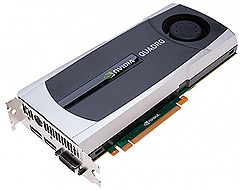
NVIDIA Announces Fermi-Based Quadro Cards at SIGGRAPH At the SIGGRAPH conferance in Los Angeles, NVIDIA announced their new line of Quadro cards based on their beefy, Fermi chipset. These cards are purchased for professional applications such as medical imaging, physics simulations, and other insanely computational heavy studies. Quadro cards are generally used for their ability to out-scale CPU solutions, with the current stable seeng a 5x increase in performance, and 8x increase in simulation capabilities.

The fermi flavored Quadro cards come in three SKUs; 4000, 5000, 6000, and the Plex 7000. The Plex is actually an array of cards, rather than a single unit like the others, meant for extreme applications. For examples of what the Quadro cards can do, take a peak at the videos blow, produced by NVIDIA. Here's the spec breakdown:

Quadro 4000: 2GB GDDR5, 256 CUDA cores, $1,199. Available now.
Quadro 5000: 2.5GB GDDR5, 352 CUDA cores, $2,249. Available now.
Quadro 6000: 6GB GDDR5, 448 CUDA cores, $4,999. Available in the Fall.
Quadro Plex 7000: 2 GPUs, 12GB GDDR5, 896 CUDA cores, $14,5000. Available in the Fall

[ ]

[youtube]GcSbCV6iDYM[/youtube]
[youtube]lNq8j_yWXzs[/youtube]
[youtube]EvgFpgrW-tc[/youtube]
Dani AI

Generated

As noted, this thread mixes a short-term market-share story with a product announcement. For anyone reading this years later: the practical question for a workstation buyer isn’t which vendor shipped more that quarter. What matters is whether the card and its drivers are certified and supported for the exact applications and OS you run. Vendors maintain ISV-certified lists and tested driver versions for a reason—those are the items that actually reduce downtime in production workflows. (nvidia.com)

Architectural details matter as well. The Fermi family introduced on‑chip caching, improved concurrency and a reorganized geometry pipeline, changes that directly affect large-model interactivity and GPGPU workloads. Those are the engineering reasons GPU vendors split “consumer” and “pro” SKUs and invest in different driver stacks for workstation use. Read the architecture notes when you need to understand why one card behaves better in a pro app than another that looks similar on paper. (nvidia.com)

Quick, practical checklist before buying or recommending a card:

  • Confirm your application is explicitly certified on the vendor/ISV list and note the tested driver revision.
  • Use SPECviewperf viewsets (or vendor-published, independent tests) that match your application to compare real-world interactive performance.
  • If you depend on simulation or scientific compute, validate double‑precision throughput and ECC behavior with representative kernels or datasets.
  • For Macs, confirm vendor Mac drivers and the exact macOS support matrix before assuming plug‑and‑play compatibility. (spec.org)

Quarterly shipment shifts and flashy spec sheets are useful context. They’re not a substitute for certification, real workload tests, and a support plan. Prioritize tested compatibility and long‑term driver support when the machine is part of a production pipeline.

Be a part of the DaniWeb community

We're a friendly, industry-focused community of developers, IT pros, digital marketers, and technology enthusiasts meeting, networking, learning, and sharing knowledge.