Windows 8: How to resurrect the Windows 7 Start Menu

Updated happygeek 1 Tallied Votes 2K Views Share

The start button does make a comeback, sort of, in Windows 8.1 but it's still not enough to satisfy the die-hard 'I got Windows 8 but miss Windows 7' brigade. Not least as when you click the Windows 8.1 start button it doesn't pop up the old folder-structured start menu that many people miss so much, but instead it just takes you back to the start screen which those same folk have such a dislike of. Of course, if you right click the start button in Windows 8.1 it does produce a start menu of sorts, with one-click access to everything from Control Panel and Task Manager through to Run and Search. If this is still not enough and you really miss the Windows 7 look and feel, all is not lost; there's an app for that.

Actually, there are any number of apps for that and the choice is quite frankly bewildering. Classic Start, however, is the most popular of the free start button apps available in the Windows Store, and having tried a few I would say it has achieved that position on merit. When I say 'available in' that's not actually really true, as all that's available there is a description of the app and access to user reviews and screenshots; to install it you have to click the link and visit the app developer website. So let's start this step-by-step tutorial right there, at the beginning...

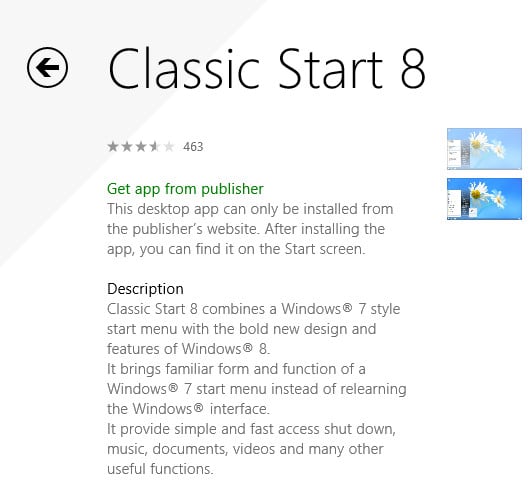
Step 1: Visit the Windows Store from your Start Screen and type 'Classic Start 8' in the search box. Select the Classic Start 8 app from the results, and then click on 'Get app from publisher'.
065ed8b2f3cd4c631f4e4b5fb069a706

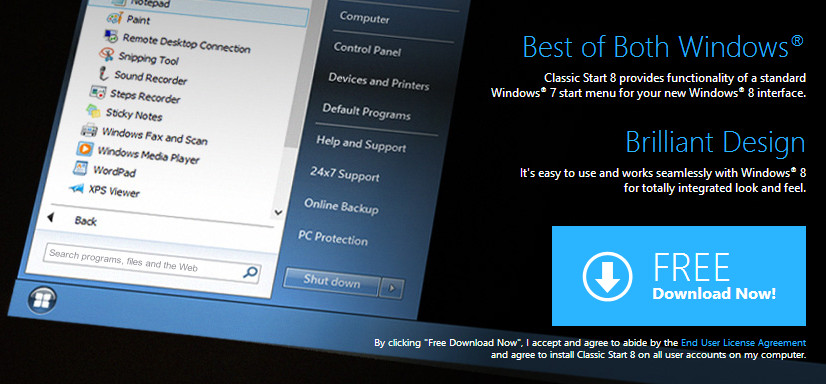
Step 2: Once at the Classic Start 8 website, click on the 'FREE: Download Now' button to start the installation process.
78af3da01a99d9d6426ee3e9817e0772

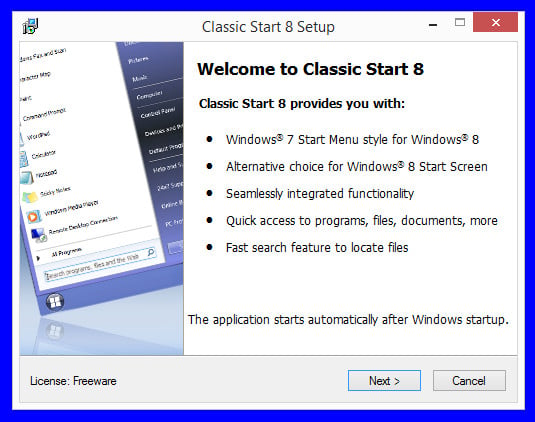
Step 3: The setup dialog will now appear, click the 'Next' button to continue.
791fe294921f733593d8d03957c7fed9

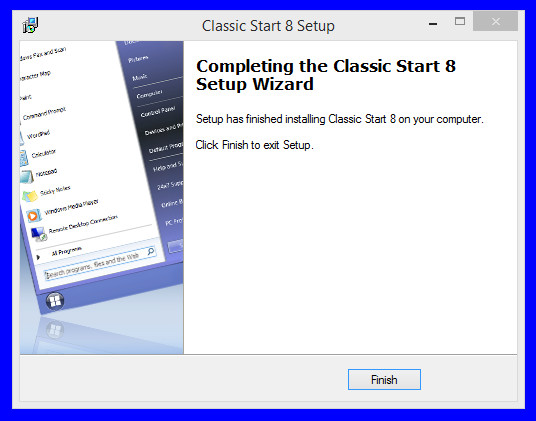
Step 4: After agreeing the terms and conditions of use, the installation will complete and you can click the 'Finish' button.
ec344ce4e480ed813b8b49ae622b8b64

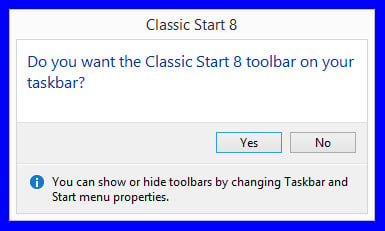
Step 5: A separate dialog will appear asking if you want the Classic Start Toolbar on your taskbar. Click 'Yes' or the new Start button will not be visible until you change your taskbar properties, which just introduces an unnecessary additional step in the process.
e0f9126310373dd0db5944f616317d50

Step 6: You will now have a second 'Start' button on your desktop taskbar, right next to the default Windows one but larger and contained within a more prominent 'button-graphic' icon.

e6a91f3d89f61009d8768b5a0cf62ab5

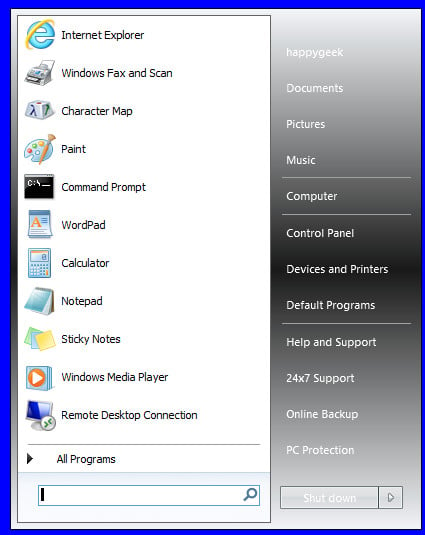
Step 7: Left click the new Start button and you will be greeted with a much more familiar, Windows 7 style, Start Menu. This menu will also appear when you press the Windows key.
0217f2b5e023420abb34300ca7b89160

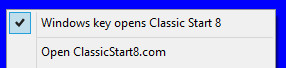
Step 8: To disable the Windows key from being used to open the Start Menu (instead of switching back to the Windows 8 Start screen) simply right click on the Classic Start 8 icon and deselect the first option: Windows key opens Classic Start 8.
884066621daa3c28ca2d98a7f42773d6

Dani AI

Generated

A few practical notes that complement 's walkthrough and the suggestions from and .

If choosing a Start‑menu replacement, prefer projects that are actively maintained or open source. Open‑Shell (the community continuation of Classic Shell) is free and widely used; paid options with solid track records include StartIsBack and Stardock's Start8/Start10 family. Use vendor or GitHub pages to confirm current compatibility with your exact Windows build before installing. Open‑Shell on GitHub (github.com) StartIsBack (startisback.com) Stardock Start10/Start8 (stardock.com)

A caution about Classic Start 8: some download hosts and removal guides have reported bundled offers and adware flags for that package, so treat installers from lesser‑known publishers with extra care — scan the installer and uncheck any optional offers. 's experience of problems after upgrading to 8.1 is the sort of thing that can happen when an extension hooks into the shell; Classic Shell itself was discontinued by its original author and later picked up as Open‑Shell. Classic Shell / Open‑Shell history (en.wikipedia.org) Classic Start 8 reports (shouldiremoveit.com)

Practical checklist before you install: create a System Restore point; install from the official vendor or via a safe packager such as Ninite when available; note how to uninstall (Control Panel / Settings or the program's uninstaller); if an update breaks the menu, boot Safe Mode to remove the add‑on or use vendor recovery tips (StartIsBack includes a disable-on-login hotkey). These steps reduce the chance that a Start‑menu tweak will leave you chasing problems after a Windows update. Ninite installer option (ninite.com)

CimmerianX 197 Junior Poster

An alternative: I just go to ninite.com, select 'Classic Shell' along with anything else I might need, download the installer and wait for all apps to install.

happygeek 2,411 Most Valuable Poster Team Colleague Featured Poster

Yep, there are plenty of 'start menu' apps out there, and Classic Shell is another good one.

dgirman 0 Newbie Poster

I greatly enjoyed reading this article. I did install a classic menu after receiving a Windows 8 system. When 8.1 came available I continued classic menu until I noticed some issues with the update. I decide to uninstall classic, and have been using the command and search options to access my apps. I greatly enjoy the command line, being a heavy linux user also.

happygeek 2,411 Most Valuable Poster Team Colleague Featured Poster

What problems were you having with Classic Start? I'm running it here under 8.1 without any noticeable problems.

Taimoor_RB 0 Newbie Poster

I really enjoyed your article although i don't have windows 8.1 and still a user of windows 7 but it was a nice move of you I appreciate your work...

goodtaste 0 Junior Poster

Thank you for this tut. I absolutely hate Win 8. It seems to get more viruses than any of the other Windows I have ever had, and I started with Windows Me!

Be a part of the DaniWeb community

We're a friendly, industry-focused community of developers, IT pros, digital marketers, and technology enthusiasts meeting, networking, learning, and sharing knowledge.