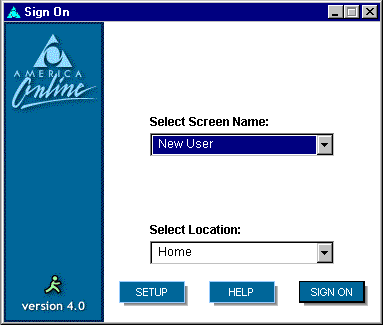
Remember back in 2001 when that 56k chorus of screeches meant you were connecting to the newfangled internet and you screamed at anyone who would pick up the phone? AOL felt pretty good about the stranglehold they had on the online market then. However, it was released yesterday morning (August 4th) that the service provider which helped herd us to the digital renaissance where dot-coms roam, in an ironic turn of events, is getting beat down by the same monster it helped create.
AOL posted massive $1.41 billion second quarter losses in writedowns after recent sales of both their Bebo social networking site and ICQ instant messaging service. Year-over-year, revenue has fallen 26% to $584.1 million, down from the $791.5 a year ago, landing well short of the expected $602 million. The company’s ad revenue also dropped 27% during a time when online sales have been booming for competitors.
"We're committed to whatever model works," said CEO Tim Armstrong, a former Google executive now at the helm of a ship headed towards rocky waters. "Advertising is our main model now, but we'll be testing other ways to monetize content in the future."
AOL acquired Time Warner Inc. back in 2001 during the dial-up boom, when free internet discs practically became currency and were inescapable from mailboxes everywhere. After the rise of broadband went straight for their communal throat, the chemistry between the conglomerates failed to create sparks. In an attempt to drive people to its Web multiple properties, AOL acquired Bebo in 2008 for $850 million, the last of its costly and failing business ventures and the straw that broke Time Warner’s back. After close to a decade long custody battle for their tumultuous venture’s well-being, AOL and Time Warner spun-off in December of 2009.
In the wake of good intentions, AOL is attempting to redefine itself by focusing primarily with online ad sales. Having severed themselves from non-core assets they once hoped would draw and preserve prospective buyers and clients—ICQ, Bebo, Digital Marketing Services Inc. (DMS), and travel site Kayak—Armstrong hopes to clear up the strings left from Time Warner’s departure.
"This is the first quarter when we were able to start playing some offense as a company," he said. "We've got a sick patient, and we're working to make it better."
Compared to its 26.7 million subscribers back in 2002, the company now maintains only 4.4 million, making for a long ascent back towards relevancy for Armstrong and company. Their sick patient better wake up out of its coma soon before somebody from its estate decides to pull the plug. The glory days, circa 2000