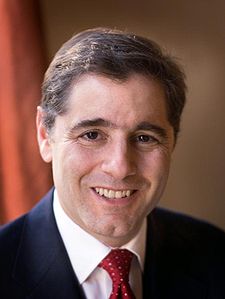
On Thursday, Federal Communications Commission chair Julius Genachowski said the he found the idea of Internet service providers offering faster speeds for users willing to pay extra fees "unacceptable."
His statement was in reaction to rumors earlier this week that Google and Verizon were working on an agreement that would open the way for Verizon offering such a distinction in service. The Commission has been working on its own talks with large Internet service provider and content companies, but news that Google and Verizon might be working on a deal of their own brought the talks to a halt. Google has denied the rumors and said that it will continue to maintain its pro-net neutrality stance.
Such an agreement between Google and Verizon poses a threat to . The term net neutrality has taken on, as politically charged terms often do, different meanings for different people. Some tech advocates say it's important to keep the Internet accessible to everyone, while others feel that the government should not be interfering with commercial efforts and impeding innovation through overregulation.
The FCC has adopted the following principles:To encourage broadband deployment and preserve and promote the open and interconnected nature of the public Internet, consumers are entitled to access the lawful Internet content of their choice.
To encourage broadband deployment and preserve and promote the open and interconnected nature of the public Internet, consumers are entitled to run applications and use services of their choice, subject to the needs of law enforcement.
To encourage broadband deployment and preserve and promote the open and interconnected nature of the public Internet, consumers are entitled to connect their choice of legal devices that do not harm the network.
To encourage broadband deployment and preserve and promote the open and interconnected nature of the public Internet, consumers are entitled to competition among network providers, application and service providers, and content providers.
Genachowski has proposed making these guidelines a set of formal rules and adding two more concerning non-discrimination, specifically stating that ISPs cannot discriminate between types of content and privilege some over others, and transparency, forcing ISPs to inform their users regarding their network management practices.
This is not about protecting the Internet against imaginary dangers. We’re seeing the breaks and cracks emerge, and they threaten to change the Internet’s fundamental architecture of openness. This would shrink opportunities for innovators, content creators, and small businesses around the country, and limit the full and free expression the Internet promises. This is about preserving and maintaining something profoundly successful and ensuring that it’s not distorted or undermined. If we wait too long to preserve a free and open Internet, it will be too late.
The topic of net neutrality and how it relates to the FFC's ability to regulate Internet-related companies is a hot topic politically. H.R.4748, the Internet Freedom Act of 2010 (also known as the Net Neutrality Act) introduced by Republican Representative David Wu, is currently under consideration by committee. It's the third time this bill has been introduced since the first time it was brought up by Democratic Representative Edward Markey.Internet Freedom Act of 2010 - Directs the National Science Foundation (NSF) to establish the Internet Freedom Foundation to: (1) award grants, agreements, or contracts to develop deployable technologies to defeat Internet suppression and censorship; and (2) award incentives to organizations that successfully develop such technologies. Expresses the sense of Congress that the United States should: (1) denounce governments and private entities that restrict, censor, ban, and block access to information on the Internet; and (2) support the deployment, at the earliest practicable date, of technologies aimed at defeating state-directed and state-sponsored Internet suppression and the persecution by governments and private entities of individuals who use the Internet.
In response, Republican Member of Congress Cliff Stearns has introduced a bill, calling for "neutral network neutrality," which some say is designed to hamper FCC efforts towards net neutrality.[youtube]L11kLmWha6o[/youtube]