Update: Google and Verizon Respond to Net Neutrality Agreement Rumors

Updated Emily Banks 0 Tallied Votes 553 Views Share

In a new development to news earlier today that Verizon and Google were nearing an agreement that might end net neutrality, both companies have now released statements to the contrary.

In Google's case, the statement came as a Tweet around mid-day Thursday.

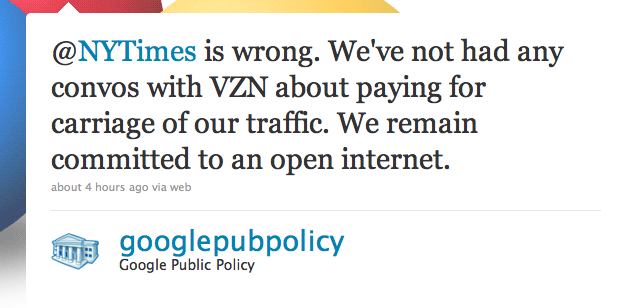
"@NYTimes is wrong. We've not had any convos with VZN about paying for carriage of our traffic. We remain committed to an open internet," the Tweet said. Verizon had posted a similar on its Policy Blog shortly before that.

"The NYT article regarding conversations between Google and Verizon is mistaken. It fundamentally misunderstands our purpose," David Fish wrote. "As we said in our earlier FCC filing, our goal is an Internet policy framework that ensures openness and accountability, and incorporates specific FCC authority, while maintaining investment and innovation. To suggest this is a business arrangement between our companies is entirely incorrect."

The New York Times article , which was first posted online Wednesday, didn't name the source of the information. It only credited "people close to the negotiations who were not authorized to speak publicly about them."
Dani AI

Generated

As ' post shows, press stories about private talks often become shorthand for a much bigger policy fight. The real issue for engineers and site owners is what ISP practices look like in technical and business terms — things like blocking, throttling, and paid prioritization — and why those practices matter for competition, speech, and innovation. EFF — Net Neutrality overview. (eff.org)

For web operators the immediate worry is measurable user impact, not headlines. Any arrangement that makes some traffic consistently faster for certain users (or slower for others) changes perceived site quality: load times, bounce rates and real-user engagement. Google has explicitly called out page speed as a ranking signal for mobile and recommends measuring real-user performance with PageSpeed tools and Core Web Vitals. Google — Using page speed in mobile search ranking. PageSpeed Insights overview. (developers.google.com)

Practical steps to protect availability and detect ISP-specific problems:

Quick commands to try from a workstation:

# Linux/macOS
traceroute -I example.com

# Windows
tracert example.com

# basic latency + total time with curl
curl -o /dev/null -s -w "time_total: %{time_total}\n" https://example.com/

Follow policy proceedings (ECFS dockets) and advocacy groups if engagement is desired; organizations like EFF provide guidance and templates for public comments. Take action / EFF resources. (act.eff.org)

Be a part of the DaniWeb community

We're a friendly, industry-focused community of developers, IT pros, digital marketers, and technology enthusiasts meeting, networking, learning, and sharing knowledge.