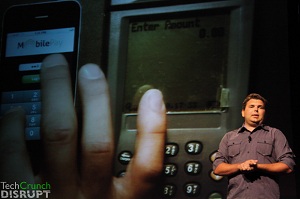
For years now, we've been promised new technologies that would merge the idea of virtual payments with actual brick and mortar retailers, but inevitably we just keep swiping those plastic cards. Meanwhile, the Japanese and others leapfrog ahead, happily waving their phones and other gadgets in front of those cool Near Field Communication (NFC) payment systems without ever having to fumble for a wallet.
The problem, according to MobilePayUSA Founder Randy Smith , is that while financial institutions and others have tried to push adoption of NFC here, retailers have balked at the up to $500 price tag to replace existing terminals with the new technology.
Smith says he's come up with a solution, and the folks attending this week's TechCrunch Disrupt conference named MobilePayUSA's geolocation-based work-around an audience favorite.
We spoke to Smith at Disrupt about the advantages of his system, which will be centered around a GPS-enabled smartphone app.
"It requires no new hardware, no new software or custom integration... no Bluetooth, no bar codes, so no changes to existing merchant systems with our solution," he explains. "We'll be able to get a merchant signed up in a matter of minutes once we're into our beta and launching commercially. We just need to capture basic merchant account information in order to achieve that."
Smith explains that using a phone's geolocation tools, the merchant is automatically displayed through the app. A payment is initiated by tapping a PAY STORE button, and once the store is confirmed and the consumer's PIN and payment amount is confirmed, a payment confirmation will appear simultaneously on the phone and the merchant POS terminal. Soon after, a receipt will be sent via email and may also be viewed online.
Smith says the system integrates fully with existing retail infrastructure.
"We ride the existing rails of the merchant payment systems from the terminal to get to us. We authorize the transaction, we receive a consumer authorization that will initiate an actual transaction by the card of choice from the consumer's eWallet."
Critics of virtual payments often cite concerns with security and potential fraud, but Smith points out that MobilePayUSA will add an additional firewall of security because, as with Paypal, the actual bank account or credit card numbers are never transmitted. He says they also plan to screen users when they sign up for the service.
"When people sign up their cards and they provide their phone numbers, we're going to screen those numbers and match their data that they provide us in multiple ways... from phone carrier records, to credit card company records to public records and even credit data before we activate that account and allow them to go use it. Because, if we do that it's gonna make it even that much more valuable to all the merchants knowing that it's pre-screened against fraud."
Smith says they're hoping to launch a nationwide private beta test during the holiday shopping season and possibly have a full-scale public debut by the end of the year or early 2011. He adds that MobilePay could have big news much sooner than that, too...
"As far as merchant signings, we could have major merchants signed in the next two weeks."
He says the company has staff with deep connections in the retail world, as well as in the ever-expanding universe of loyalty programs, which MobilePayUSA also plans to integrate into its payment services.
"In the near future, we’ll be offering Virtual Loyalty and Gift Cards. You’ll even be enabled to virtualize your existing ones!" shouts one of the company's recent releases from the Disrupt conference.
Smith says they also are looking at adding the ability to pay utility bills and even send money to friends. He says it's all part of the company's mission to make the old-fashioned wallet and check book totally obsolete, finally.