How do consumers engage with marketers today and what does the future hold? Those were the questions posed by the Greenlight . The answers might come as something of a surprise to those who had all but written off Google+ or think that Facebook couldn't be a search player.
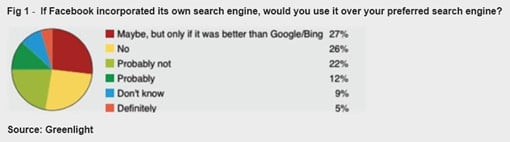
 The simple fact is, as revealed by the Greenlight questioning of a cross-section of consumers, if Facebook was to launch a search engine tomorrow it could immediately soak up a 22% share of the global search market. That would be enough to turn it overnight into the second most utilised search engine on the planet, or at least within every major market with the exception of China, Japan and Russia where it would sit third in the utilisation pecking order. The research results also suggest that the global market share projections could grow to 50% within "a few years" by converting what you might describe as Google waverers, those users with the least loyalty to the Google search brand. Some 27% of those asked said they might use Facebook for search if it offered a better experience than Google or Bing.
According to Greenlight COO Andreas Pouros, the Facebook search engine isn't something that should be thought of as pie in the sky thinking as it's a product which could be pretty easy to launch given the membership of the social network and the appetite they have for the Facebook experience. "It wouldn't need to be a spectacular engine either" Pouros insists "just well integrated into the Facebook experience and generally competent."
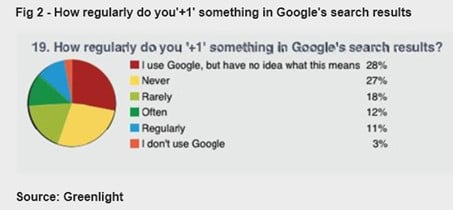
As for Google+, the social network all but written off by many industry commentators, it could be doing better than you think. The Greenlight research found that 23% of Google users have been hitting the +1 button for listings in search results. That doesn't compare all too badly with the 35% of Facebook users who 'like' brands or company pages on the social network. In fact, it rather suggests that the social signal collection of both are in similar ballpark territory. As soon as Google manage to convert the 28% of users who have no idea what the +1 actually does, then Facebook could be in for something of a wake up call as far as this kind of social signalling is concerned.
What does emerge more than anything else from this survey is that both in the short term and for the long haul, it looks like Facebook and Google+ will be at the forefront of the social search phenomena and this will have to be considered when looking at site SEO. It is no longer to just be relevant, they now also need to be socially valid. “Brands and e-retailers need to be encouraging +1's in Google, as it isn't something that might be important in the future - it already is!" Porous concludes "It affects natural search rankings and will have an increasing impact over time across every Google product they utilise - AdWords, price comparison, Shopping, YouTube, etc., and Facebook could be a major search engine overnight. As such a brand’s performance on Facebook today (likes, visits, etc.) will likely have a decisive impact on how well exposed it is on that new search engine.”