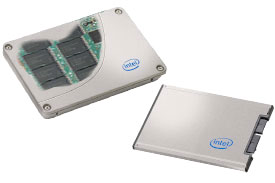
You may have noticed that solid-state drives (SSDs), those flash memory-based drives that were touted as an alternative to hard disks, have remained stuck in the 80GB to 160GB size range and the prices are not coming down.
There's a good reason for that. Starting in early 2009, the price of NAND flash memory took off, almost doubling in price, and proceeded to stop the momentum of SSD as a storage alternative in its tracks.
But now, thanks accelerated deployment of new manufacturing plants, the supply of NAND flash is poised to drastically increase. This in turn should help drive down the price and hopefully give SSD back some momentum. SSD has lost a lot of ground to traditional hard disks, which have broken the multi-terabyte barrier for less than the cost of a 120GB SSD drive.
"The consumer has yet to find a set of benefits commensurate with the premium price SSD commands," said Michael Yang, senior analyst for memory and storage at iSuppli. "With any type of item, everything has a price. People will say that for this set of benefits I'm willing to pay this price. People just are not seeing that with SSD. The price is too high compared to traditional hard drives."
The downturn in the economy in late 2008 played a part, but indirectly. In early to mid-2008, NAND flash cost about 90 cents per gigabyte. With the late 2008 downturn, companies cleared out inventory and didn't restock. For a while, that was great news; Yang said the price of NAND dropped 30 percent in the final quarter of 2008.
After everybody cleared out their inventory, suppliers cut their manufacturing capabilities in half. They shut down older lines and focused on newest, most profitable products. "Demand didn't fall of 40 to 50 percent but production did. As a result, the price rebounded," said Yang. That caused NAND prices to skyrocket to more than $2 per gigabyte.
Memory makers have been scrambling to bring on capacity. Samsung and Toshiba are expected to open major production lines next year. New process technology will also help. Intel and Micron just announced new 25nm flash, which replaces the 34nm chips they've been making for a while.
"A smaller die size means more chips per wafer, which in turn means more supply. Also, they are going from two bits per cell to three bits per cell," said Yang.
There are two types of flash memory, single-level cell (SLC) and multilevel cell (MLC). Each cell is a transistor, and each memory chip can only hold so many cells. By going from two bits per cell to three, capacity per chip is increased by one-third.
iSuppli projects that 1GB of 3-bit per cell NAND flash memory will average $1.20 in the fourth quarter of this year then decline to $1.00 at the end of the year. That's a major drop from the beginning of this year, when 3-bit MLC averaged $1.80 per gigabyte and 2-bit MLC was at $2.05.
However, SSD has lost so much ground to standard hard disk drives that the price would have to plunge to around 40 cents per gigabyte by 2012 to be price competitive. Otherwise they risk losing so much ground that SSDs might never regain their competitive footing.
Even at 40 cents, a 100GB drive would still be $50. Yang does not see SSD drives making the quantum leaps in capacity like hard disks have traditionally done, either. "If you double the memory capacity, you double the cost. There's no way around that," he said. So it's unlikely we will see 1TB-2TB SSD drives any time soon.