Eaton's 5PX UPS is First to Implement Energy Metering down to the Outlet Group

Updated WASDted 0 Tallied Votes 843 Views Share

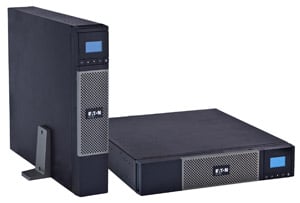
Last year we reviewed Eaton’s 5130 UPS and it was almost perfect. Today Eaton announced the new 5PX UPS to replace the 5130, and hopefully improve it. One of the key new features of the 5PX line is energy consumption metering down to the outlet group level; this is an industry first. Also included is an intuitive LCD screen that displays all the information IT managers need in one quick glance. Energy consumption levels as well as a wealth of other information can also be viewed via Eaton’s Intelligent Power Manager software. This new 5PX line will range from 1.5kVA to 3kVA and can provide up to 99% efficiency to help reduce cooling and utility costs. It also sports a power factor of 0.9, which allows it to protect more servers or devices than the competition. That’s nice because typical UPS power factor ratings are around 75% or 0.75; the higher the pf the better.

All of the Eaton 5PX UPS units can stand in pedestal mode or be rack-mounted (2U) with the included rails. We are currently evaluating a 5PX 5PX1500RT , the 1500VA version, so stay tuned for a full review coming soon.
Dani AI

Generated

For anyone evaluating the Eaton 5PX's outlet-group metering, the practical question is how to turn those per-outlet numbers into reliable decisions. Below are repeatable checks, real uses, and cautions that complement the thread discussion and help make the metering feature actionable over the long term.

  • Map every outlet to the exact device (include model/serial). Meter data without a map is hard to interpret.
  • Capture a baseline for 48–72 hours that includes normal business hours and a maintenance window. Short snapshots can miss important peaks.
  • Run a controlled startup sequence for devices that share an outlet group to reveal inrush spikes and breaker/PDUs risks.
  • Cross-check meter readings on a small sample with an independent clamp meter or inline wattmeter to verify accuracy and detect calibration drift.
  • Confirm logging/export capabilities: sample interval, CSV/JSON export, NTP time sync, and support for traps/APIs so data can be integrated into monitoring/chargeback systems.

How the data is useful

  • Capacity planning: convert average watts into kWh over a billing period to size future racks and cooling needs.
  • Runtime comparison: use a simple estimation for comparisons — Runtime_hours ≈ (battery_energy_Wh * inverter_efficiency) / measured_load_W — but rely on vendor runtime curves for absolute numbers.
  • Operational controls: create alert thresholds, use metered groups to automate graceful shutdowns, and stagger power-on sequences to avoid simultaneous inrush.

Cautions and context

  • Meter averages can hide short peaks; sample resolution matters.
  • Outlet metering does not replace breaker or PDU verification; both levels should be checked.
  • Firmware, calibration, and reporting intervals can change results—document versions during any test.
  • As noted in the thread, topology choices affect overall protection strategy; regardless of topology, outlet-level visibility is valuable for troubleshooting, energy programs, and chargeback. The hands-on evaluation mentioned by should clarify runtime and accuracy details that readers like were waiting for.
Macebedo 0 Newbie Poster

I would be more likely to go with a Liebert GXT3 model since its a true on-line UPS system and not a line interactive model as the 5PX. On-line with no switch-over time and AC power converted to DC and back to AC is cleaner power to my loads.

Mike in Hawaii

nickadam 8 Newbie Poster

Terrific post, I’ve bookmarked this site so hopefully I will discover much more on this topic in the foreseeable future

Be a part of the DaniWeb community

We're a friendly, industry-focused community of developers, IT pros, digital marketers, and technology enthusiasts meeting, networking, learning, and sharing knowledge.