Prototype search engine peers into future

Emily Banks 2 Tallied Votes 750 Views Share

Sure, looking for news stories with a search engine can tell you about the past, but a new application might act more like a very comprehensive crystal ball. A search engine prototype created by Yahoo's Barcelona lab lets users look into the future -- sort of. The was revealed this week as part of the Human-Computer Interaction and Information Retrieval challenge , which uses more than 1.8 million New York Times articles from 1987 to 2007 as its data set. The application is also part of the European project .

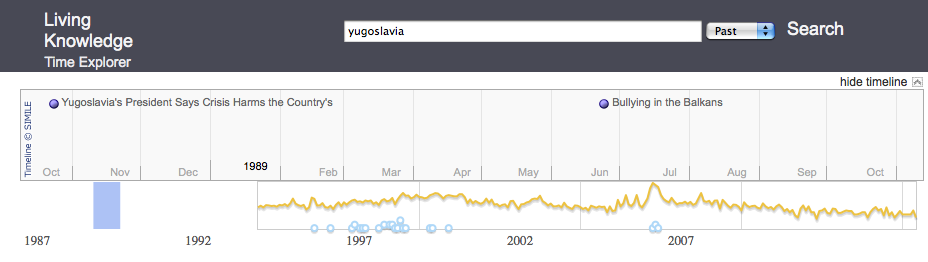
The Yahoo researchers call their creation "Time Explorer" and describe it as "designed for analyzing how new changes over time." Time Explorer expands on our current use and understanding of search engines.

"First, Time Explorer is designed to help users discover how entities such as people and locations associated with a query change over time. Second, by searching on time expressions extracted automatically from text, the application allows the user to explore not only how topics evolved in the past, but also how they will continue to evolve in the future," the researchers wrote in their HCIR challenge paper). "Finally, Time Explorer is designed around an intuitive interface that allows users to interact with time and entities in a powerful way."

Time Explorer goes beyond our current notions of news search engines, which for the most part retrieve stories in reverse chronological order, giving relevance to those stories that are most recent. Currently, users are unable to ascertain a broader understanding of a news story.

So Time Explorer seeks to remedy that by placing news stories on a timeline that reaches both into the past and the future.

"When searching about a regional conflict, for example, a user should be able to identify what factors lead to the conflict, which people where most influential and when, and how the conflict is likely to evolve in the future," the researchers wrote.

Time Explorer extracts temporal information that includes metadata, like when the story was published, and expressions from within the text, like for instance statements about future events. The application also identifies other entities like names of important figures.

"The application includes many features that, in combination, we believe improve upon what is currently available in news search. Most notably, the tight integration between the trend graph, the topic timeline, and the entity list and the ability to search into the future, but also a user interface which allows for easy query renement while still providing visual clues that allow the user to understand how he arrived at the current state," the researchers concluded.
Dani AI

Generated

Following ' summary of the prototype that surfaces "future" signals in news, the notes below outline practical design, validation, and UX points useful for anyone studying or building similar functionality. 's mention of social signals (Digg/votes) is relevant only as noisy, secondary evidence and should not replace robust temporal parsing or provenance.

Architectural checklist (modular pipeline)

  • Normalize each article to a reliable source timestamp.
  • Extract and normalize time expressions (absolute dates, relative phrases) and tag intent: scheduled vs speculative. Detect hedging words (may, could, expected) so the UI can treat those predictions differently.
  • Run entity extraction plus coreference so mentions of the same person/event are linked across articles.
  • Cluster mentions into canonical events and build time series for each entity/event. Use smoothing and burst/change-point detection to find meaningful trends.
  • Forecast cautiously: simple extrapolation or lightweight time-series models can give short-range signals; always attach confidence intervals and the contributing evidence.

UX and presentation principles

  • Never show a "prediction" without provenance. Display representative headlines/sentences and the publication dates that drove the signal.
  • Visually separate scheduled facts (e.g., announced dates) from probabilistic forecasts; use color or labels and let users filter by certainty.
  • Make timelines interactive: brushing, drill-down to example sentences, and incremental query refinement help users judge relevance quickly.

Evaluation and cautions

  • Backtest aggressively on held-out historical slices: measure event detection precision/recall and timing error for predicted dates.
  • Expect common failure modes: stale scheduled mentions, ambiguous relative times, and overfitting to short-term buzz. Treat social counts as features, not ground truth.
  • Provide clear uncertainty language and provenance to avoid presenting conjecture as fact.

These steps focus on making "future-looking" search transparent, testable, and useful rather than merely novel.

GoodLuckChuck 0 Junior Poster in Training

I like anything that has to do with time travel. I Dugg this story or Digged this story and saw that I have 11 followers. I do not know who they are or where they camce from but I do know that no one has a head start on me since they just started doing this. I Dugg another story on here first but I was not the first one so it did not take me to the Digg page.

Be a part of the DaniWeb community

We're a friendly, industry-focused community of developers, IT pros, digital marketers, and technology enthusiasts meeting, networking, learning, and sharing knowledge.