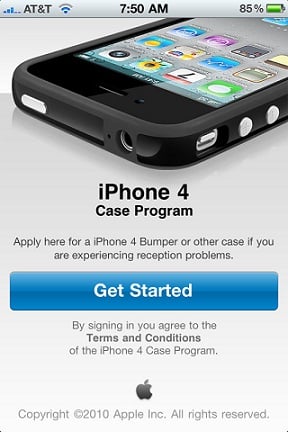
The iPhone Case Program was announced earlier this morning, just a week after Apple CEO Steve Jobs addressed the reception issues spreading through the news like wildfire. In his shrugging off of the recent headlines, Jobs explained that only 1.7% of iPhone 4s have been returned and that just 0.55% of owners have called to complain. Regardless of the numbers, free bumper cases were the solution given by Jobs, which allows the external antenna band room to breathe in between the purchaser’s kung-fu grip. It’s now time for you to cash in.
Users in dire reception straights looking to gain better bars will hopefully find a hot spot to download the app released to accept iPhone 4 bumper case requests. You read that right—an app. I’m not sure if making its users download an app to initiate the process in receiving a free case is ingenious or pretentious.
As per instructions via the Apple site:Download the iPhone 4 Case Program app from the App Store.
Launch the app on your iPhone 4 and sign in using your iTunes Store account or Apple ID.
Select your Bumper or case.
[INDENT]For iPhone 4 purchases made before July 23, 2010, you must apply no later than August 22, 2010; otherwise, you must apply within 30 days of your iPhone 4 purchase. To qualify for this program, you must purchase your iPhone 4 by September 30, 2010.[/INDENT]Owners will have the option of selecting an Apple Bumper (available only in black), or from one of the following third-party choices:Incase’s Snap Case (smoke or clear varieties)
Belkin Shield Micra
Griffin’s Motif (diamond and smoke varieties)
Reveal’s Etch (black and black graphite varities)
Speck’s Fitted Case
PixelSkinHD
If you already purchased an official bumper for $29 from an Apple or AT&T store, your options for a refund lie in your respective form of payment:
Credit card:
Apple has already refunded the money to your account. Many users have reported receiving texts from
Cash, check, or gift card at an Apple Retail Store:
You will need to return to the point of purchase with your receipt by September 30, 2010.
If you purchased one from an AT&T store:
Owners must fill out and mail it to Apple before September 30, 2010.
Hate your iPhone 4 for all it’s worth:
Return it to any Apple Retail Store or the Apple Online Store within 30 days of purchase for a full refund.
To help combat the complaints and help better understand issues its users were having, Apple constructed a $100 million building designed as a state-of-the-art testing facility, doubling as a great publicity stunt. Their verdict? Spend $175 million more on the iPhone Case Program.
Photo courtesy of Engadget.