I am trying to help a customer restore their connectivity to their server.

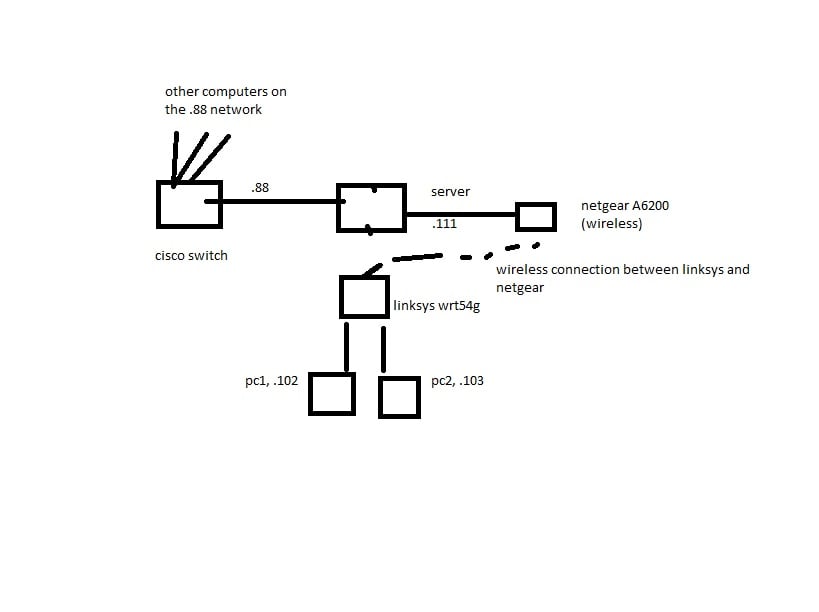
earlier this week, a power outage wiped out thier servers' internet connection and the connection to 2 computers, I'll call them 1 and 2. We advised them to replace the wireless usb adapter they were using to have internet connectivity on 1, 2, and the server only. Here is the way this is all connected:

the server (windows XP sp3) has a wired connection (.88) that goes to a switch, and allows those computers to connect to the server, no problems there.
the server has a wireless USB adapter (Netgear A6200) coming off of it (.111) that wirelessly connects to the router (Linksys wrt54g)

PC1 (xp as well) has an ip ending in .102, it is wired to the linksys router directly.
PC2 (Windows 7, ip ends in .103) connects to the linksys router.

server, pc1, and pc2 all connect to the internet. I can ping the gateway (router) from all 3. I can ping .102 from .103, and .103 from .102, but I can't ping either .102 or .103 from the server (again, which is .111) and I can't ping .111 from pc 1 or 2. They all connect to the internet, looking at the dhcp client table in the linksys router, all 3 are seen.

I tried to disable the wired connection (.88) from the server, and suddenly server, 1, and 2 worked in harmony, but the switched computers couldn't connect to the database.

There is no authentication turned on the router, no firewall settings blocking anything.

The customer swears this configuration worked before the power outage and replacing the usb adapter coming off the server. I can't figure out why tis is happening.

Dani AI

Generated

Good diagnosis by and useful detail from . The behavior described is the textbook symptom of a host with two physical interfaces configured on the same IP subnet: Windows will make routing/ARP decisions per its routing table and interface metrics, so packets can enter on one NIC and leave on the other, producing the inability to ping peers on that subnet even though Internet access works. Disabling the wired NIC removed the ambiguity; moving the router/clients to a different subnet removed the conflict permanently.

Quick, repeatable checks (run on the server):

ipconfig /all
route print
arp -a

What to look for: two IPv4 addresses that share the same network/prefix, more than one 0.0.0.0 (default) route, or an unexpected interface metric that causes traffic to prefer the wrong NIC.

Practical fixes and options

  • Put the two physical segments on different subnets (recommended). That is the least error-prone solution and is what fixed the thread (router/clients on 192.168.2.0/24 while the server’s other NIC stayed on 192.168.1.0/24).
  • Remove the default gateway from the non-internet-facing interface (TCP/IP properties -> Advanced -> Gateway). Only the interface that should reach the Internet should have a default gateway.
  • If the server must reach both subnets, add specific persistent routes instead of a second default gateway:
    route -p add <remote-net> mask <mask> <next-hop>
  • If the two segments must act as one L2 domain, use a proper bridge or put the AP in client/bridge mode so ARP and broadcasts are consistent (do not simply put two NICs on the same subnet).

Notes and cautions: consumer routers and wireless USB adapters can mask these symptoms by DHCP behavior; changes to subnets will require DHCP/static address updates and review of any port-forwarding or firewall rules.

Recommended Answers

All 6 Replies

Your description is a bit confusing. A network diagram with IPs would be helpful.

I don't understand why you have wired and wireless connections and a computer with both. Doesn't make sense.

server's wireless connection connects to 2 back office computers. the IP of the wireless connection is .111 The wifi adapter is a netgear A6200 usb.
the server's wired connection goes to a cisco switch that connects to several other computers in another area, that ip is .88
I don't know why they did it this way, but we are trying to configure remotely and I can't reconnect myself. He says this configuration worked previous to replacing the wireless adapter.

PC1 - .102, connected directly to the linksys

PC2 - .103, connected to the linksys (192.168.1.1)

I can't draw it right now.

I can ping 192.168.1.1 from all 3 computers. I can't successfully ping the server from pc1 or 2, nor can I ping 1 and 2 from the server, but they can all use the internet, so the server is connecting to the router, just not the wired ports off the router.

When I disable the wired (.88) connection on the server, the above problems disappear.

99597c59fa716f1101cbc36d7f25884c

This post has no text-based content.

Based on your description, the .88 interface should be set up on a different subnet, say 192.168.2.x/24 assuming the hosts on the cicsco switch do not require connectivity to the Linksys router or pc1 or pc2.

The problem that I see is that your win XP computer has two interfaces on the same subnet, but physically they are two different segments. Packets are likely coming in the the .111 interface and leaving out the .88 interface likely because .88 has a higher priority in the routing table or because .88 is configured with a default gateway which is should not be. Only the .111 interface should have a default gateway of 192.168.1.1.

Changing the Linksys router to 192.168.2.1 fixed the problem. thank you

Glad to hear it resolved your issue. It was evident once you posted a diagram/description that it would be resolved with a slight config change.

Be a part of the DaniWeb community

We're a friendly, industry-focused community of developers, IT pros, digital marketers, and technology enthusiasts meeting, networking, learning, and sharing knowledge.