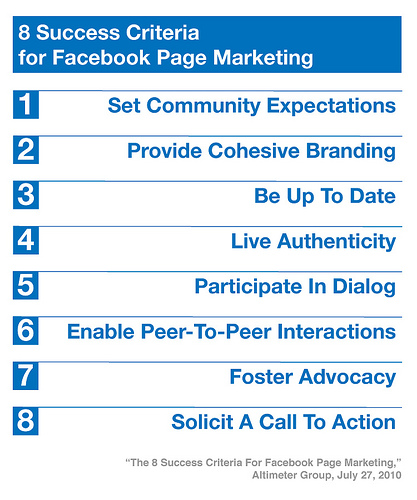
Altimeter Group's recently released report establishes eight criteria for measuring success with Facebook page marketing and used the criteria to measure thirty brands, finding that the majority aren't making the most of their Facebook pages. Pamper's, Macy's, Kohl's and AXE, on the other hand, were brands successfully using Facebook marketing to increase word of mouth and brand recognition. More and more companies are using Facebook to reach customers, with more than 45% of senior marketers identifying social networks as their priority for this year.
Facebook, the report says, is a platform that marketers cannot ignore. Recently Facebook passed the 500 million user mark, with users spending more time on Facebook each day than on Amazon, Google, Microsoft, Wikipedia, Yahoo, and YouTube combined.
So what are the eight criteria? Setting community expectations, providing cohesive branding, staying up to date, maintaining live authenticity, participating in dialog, enabling peer-to-peer interaction, fostering advocacy, and soliciting a call to action.Setting community expectations: Companies need to tell consumers both what they can expect from the brand's Facebook page, such as news, tips, coupons, or user support, as well as what the company wants from fans. Posting community guidelines and moderation guidelines helps users understand why inappropriate content might be removed.
Providing cohesive branding: Companies should make the most of Facebook customization in order to make their band distinctive. They may want to create custom applications or tabs that help provide a distinctive brand experience.
Staying up to date: Pages need to stay fresh, both to entice new users and to give followers a reason to stay engaged with the brand's page.
Maintaining live authenticity: Brands should make the most of the people-to-people connections that Facebook offers by creating a conversation with their followers, using administrator names and photos to reinforce the user's sense of engaging with another human being.
Participating in dialogue: Brands should respond to fans in discussions as well as initiating its own discussions. Fan comments should be acknowledged to make consumers feel appreciated and encourage them to share their interactions with the brand with other friends.
Enabling peer-to-peer interaction: Fans should be able to respond to each other, and offer each other support. This requires a community policy and moderation to facilitate that interaction.
Fostering advocacy: Encourage fans to share or like posts by having them do something on the page, such as voting in a poll, that is worth sharing with their friends. Contests, polls. and submissions all invite users to participate and share.
Soliciting a call to action: Give fans something to do other than simply read posts by asking them to "Like" or share items or sign-up for the brand's newsletter.
In looking at brands, Altimeter found that retail industries and consumer goods/products tended to use Facebook more effectively than luxury hotels or regulated industries. Most brands fell short in setting expectations although brands currently facing controversy, such as BP, tended to score high in this area.