have you ever bought a pc with a large hard drive, and two days later , you come to find that a large chunk (about 15gb/103gb) of your new drive missing? Well, when this happened to me, i shutoff system restore, and as quick as day, i got my 15gb back!! In my opinion, system restore has no use for me, but for others, it may be necessary. If you want to keep system restore on, but save disk space, the command below can reduce the space taken by system restore on any hard disk in your system!! The example below reduces system restore space to 3 GB on the C:/ drive:

vssadmin resize shadowstorage /On=C: /For=C: /Maxsize=3GB

Please test this out, and tell me what it did. On my pc, i did use it, but i turned system restore off completely to save disk space. Please post your thoughts on this tweak, and what i chose to do with system restore. If you ever need a tweak, write a post with two stars before the title so i can know you really need one, and i will search and see if i can find you one.

Dani AI

Generated

This thread shows why System Restore (System Protection) can look like a big sink of space and why some people simply turn it off. correctly noticed reclaiming space by disabling restore points, but that also removes the safety net those points provide. is right that restore points are a lightweight rollback compared with full images, and correctly notes GUI options exist on older Windows — Vista still exposes per‑volume System Protection controls, so turning everything off isn’t the only choice.

Quick, accurate facts and safe steps not yet covered here:

  • Vista keeps restore data in a reserved shadow‑copy area per volume. The System Protection tab in System Properties lets you select a drive, click Configure and delete or limit how much space is reserved (so older points are purged as needed).
  • Don’t disable System Restore if there aren’t reliable full‑image backups available. If the goal is to free space but retain recovery ability, reduce the per‑drive quota or delete older points while keeping recent ones.
  • If a brand‑new PC seems to “lose” 10–20+ GB, also check Disk Management for a hidden OEM recovery partition — manufacturers often reserve space for factory images.

Practical checklist:

  • Inspect System Protection for each volume and reduce quota if necessary.
  • Confirm whether an OEM recovery partition exists (Disk Management).
  • Create at least one full disk image to external media before disabling recovery features.
  • If malware is suspected, clean the system first; infected files can persist inside restore points.

For advanced control of shadow storage and technical details see Microsoft’s vssadmin documentation and general background on System Restore:
vssadmin (Microsoft)
System Restore (overview)

Recommended Answers

All 6 Replies

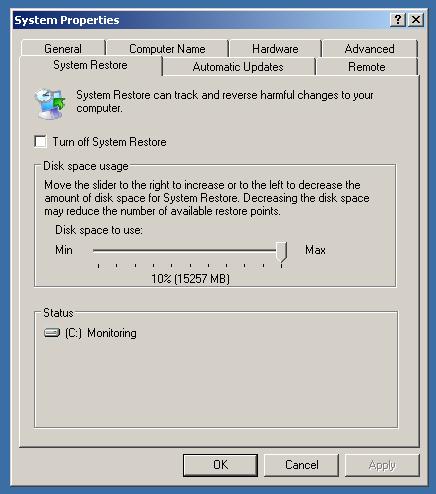
Theres no need for the command

All the options (in xp) are under control panel -> system

screenie included

its worth rembering system restore is a great tool (when it works) and can help recover your computer to an earlier time. It also doesnt use up as much space as a backup. And i think in vista you do have to use the command forumdude suggested as the option of disk usage isnt avaliable as a menu!! good advice though guys!

np

system restore is good. Only problem is that viruses sometimes hide in it

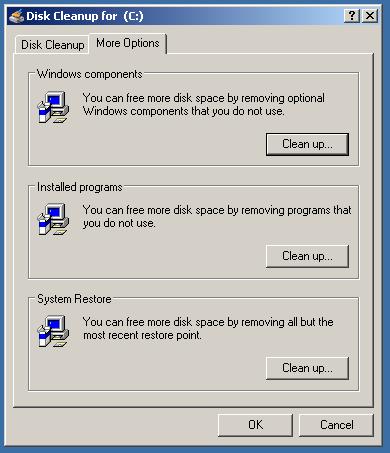
you can save space by deleting all but the most recent poing under disk properties -> disk cleanup (in xp)

Theres no need for the command

All the options (in xp) are under control panel -> system

screenie included

as you can see this is a VISTA post, and the command prompt was needed for vista. and remember that some just like the prompt rather than the gui for changing some settings.

its worth rembering system restore is a great tool (when it works) and can help recover your computer to an earlier time. It also doesnt use up as much space as a backup. And i think in vista you do have to use the command forumdude suggested as the option of disk usage isnt avaliable as a menu!! good advice though guys!

For an average home user, i would lower the space intake to 5GB, but some like to mess around too much and may need the full capacity available. For business users, i suggest not messing with anything, as businesses are always in need for a stable pc.

most businesses will probably use an imaging too like norton ghost instead/as well as it

Be a part of the DaniWeb community

We're a friendly, industry-focused community of developers, IT pros, digital marketers, and technology enthusiasts meeting, networking, learning, and sharing knowledge.