Hey there.

I am from group of people. That are getting heavily irritated by unexpected smash of sound above 12kHz.
Is there way to limit it, up to this? I mean, I don't have problem if I am expecting it. But when I am
playing games, watching films or listen to new music. I come very often they use these higher frequentions,
which in place of bringing me fun, give me chills. I have Googled it, but everybody are only asking about highest possible
frequency on earth (1GHz^ apparentely).

^ - 1'000'000'000

Dani AI

Generated

Short answer: use a system-wide low-pass (high‑cut) filter at ~12 kHz. Equalizer APO can do that (and Peace is a much easier GUI), but it only works when it actually sits in the Windows audio path for the device you use. was right that APO is the right tool here and was right that some onboard drivers (Realtek etc.) also offer EQ — the difference is APO is system-wide and supports custom low‑pass/ IIR filters. (sourceforge.net)

Why it might have failed for : common causes are the APO not being installed for the correct playback device, apps using exclusive/ASIO mode (which bypass the Windows audio engine and APO), or HDMI/SPDIF bitstreaming (compressed passthrough) which also bypasses processing. Fix checklist: open the Equalizer APO Configurator and make sure your primary output (headphones/speakers/DAC) is selected; try the Configurator “troubleshooting / Install as” options (SFX/EFX or SFX/MFX) if the EQ seems inert; disable exclusive mode in the device Advanced properties or switch the app to shared/WASAPI shared output; avoid bitstream/passthrough if you need EQ. (sourceforge.net)

How to shape the filter without making audio muffled: a single gentle low‑pass at 12 kHz reduces everything above that point but can sound dull if too aggressive. Alternatives that keep clarity: (a) a mild high‑shelf cut starting near 12 kHz, (b) surgical notch cuts at the specific offending frequencies if the problem is narrowband spikes, or (c) chain multiple LP filters / use higher‑order IIR coefficients for a steeper roll‑off if you really want a sharp cutoff. Read up on low‑pass vs shelf vs notch behavior before committing. (craiganderton.org)

Testing and practical options: verify changes with an online tone or sweep (play 12 kHz and 16 kHz tones while toggling the EQ) — for quick checks use Online Tone Generator and confirm the filter is audible. If Equalizer APO/Peace still won’t attach to the device, alternatives are using a virtual mixer like Voicemeeter (host VSTs, per-app routing) or per-app EQs in players (VLC, foobar2000). If you try APO again, keep a simple config, pick LP or LPQ filter, save, reboot and test with a tone sweep. (onlinetonegenerator.com)

Recommended Answers

All 10 Replies

I had a similar problem. I have lost some hearing in the higher frequencies and was looking for a way to adjust the sound over all applications. I found Equalizer EPO. You can download the 32 bit version here. There is a 64 bit version available as well but you may have to look around for it. You configure it using a text file. I have written a GUI front end in vb.net which I can post if you need it.

I don't know much about different soundcards/sound chips on mobos, but I do know that Realtek has a built-in equalizer which allows frequency band adjustments.

The nice thing about Equalizer EPO is you get to define the frequencies, the number of bands, and you can specify the filter types (high, low, band-pass, etc).

@Reverend-Jim I see no options in Equalizer EPO only I can find is "Options" and "Benchmark". "Options" has only speaker and microphone section. Where it tells that it's turned on. But it doesn't limit jack.

Maybe you could give me application of yours, if you don't mind.

(My head almost exploded at 16kHz.)

I've attached two files. One is the zip file that contains the source code and compiled application. The other is an example config file. Once you install Equalizer APO, go to the folder

C:\Program Files\EqualizerAPO\config

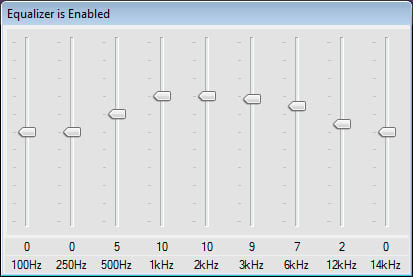
and replace example.txt with the one I posted. I'm still working on my GUI so in a newer version you won't have to do this. Also, I hope to add more options for the filters. When you run the GUI you can adjust the sliders and the config file will be updated in near real time. If you right click on any filter you can enable/disable all filters so you can see what difference (if any) your settings make. You can close the GUI (with ALT-F4) without disabling the equalizer.

Used it. It didn't limit frequency. It disabled bass almost totally.

When you run the GUI you can adjust the sliders and the config file will be updated in near real time.

What the heck are you talking about, I have only this (no slides):

My GUI is entirely separate from that. What you are looking at is the setup for the equalizer. You have to run my GUI after it is all set up. It looks like this

36c18fb8d65022179e94f00910e0b719

Until I get around to it (or until you change it for yourself) the GUI will work only for the frequencies I have defined. I hope to make the frequencies, number of bands and filter types configurable.

Yeah, I found that. It didn't limit frequencies, I put your program to equalizerapo folder. Clicked on your program. Bass wasn't reduced and higher frequencies were still there.

It's hardly worth the effort. I will have to survive it. Thanks for replying.

You can always try editing the example.txt file directly and putting in your own frequencies. Leave the edit window open and every time you do a save you should be able to hear the difference (if any). Play with the frequencies and the gains.

This was so helpful! Thank you so much!
Thanks for including the source too.

Be a part of the DaniWeb community

We're a friendly, industry-focused community of developers, IT pros, digital marketers, and technology enthusiasts meeting, networking, learning, and sharing knowledge.