Hi guys I just want to ask how to do this: "The distribution switch is connected by trunk links to the access switches."

I included the whole Phase 2 instructions so you can better understand what I am trying to do. I've done all that's in this list already except for "The distribution switch is connected by trunk links to the access switches." How do I do that? I will also attach a topology picture that I created from Packet Tracer. if you see anything wrong with the way I connected the switches please inform me. Thank you very much
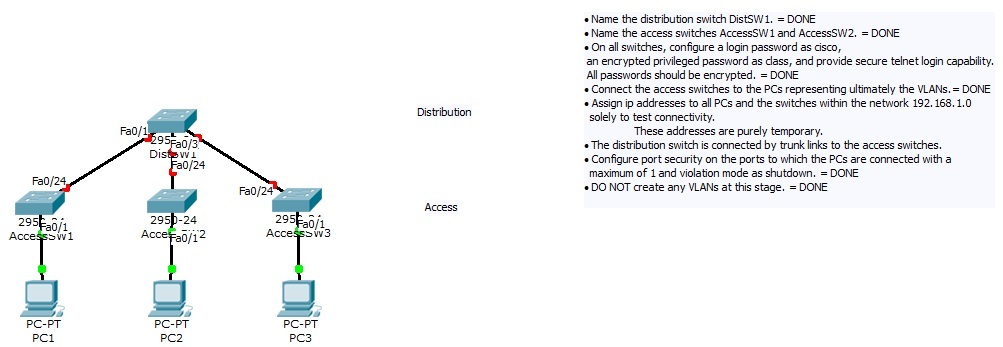
aaa

INSTRUCTIONS:

Phase 2: Basic Switch Configurations (5 marks)

-Using Packet Tracer, create and connect three access switches, one distribution switch, the servers and PCs together to form basic connectivity.
-Name the distribution switch DistSW1.
-Name the access switches AccessSW1 and AccessSW2.
-On all switches, configure a login password as cisco, an encrypted privileged password as class, and provide secure telnet login capability. All passwords should be encrypted.
-Connect the access switches to the PCs representing ultimately the VLANs.
-Assign ip addresses to all PCs and the switches within the network 192.168.1.0 solely to test connectivity. These addresses are purely temporary.
-The distribution switch is connected by trunk links to the access switches.
-Configure port security on the ports to which the PCs are connected with a maximum of 1 and violation mode as shutdown.
-DO NOT create any VLANs at this stage.

Dani AI

Generated

— The phrase about “trunk links” means the uplink ports between DistSW1 and the access switches should be configured to carry multiple VLANs (802.1Q) later on. Even if VLANs are not being created in Phase 2, set the distribution-access links to static trunk so future VLAN traffic will pass and DTP behavior is predictable. ’s caution about real-world training is understandable, but this Packet Tracer lab is exactly the right place to practise these commands.

Example CLI (adjust interface names to match the actual ports on the switches in Packet Tracer):

! On DistSW1 (example Gigabit interface)
enable
configure terminal
interface GigabitEthernet0/1
 switchport mode trunk
 no shutdown
exit

! On AccessSW1 (corresponding uplink)
configure terminal
interface FastEthernet0/24
 switchport mode trunk
 no shutdown
exit

Notes and verification commands:

  • Some switch models accept an explicit encapsulation command; if Packet Tracer rejects it, omit switchport trunk encapsulation dot1q.
  • Avoid applying port-security to trunk uplinks — port-security belongs on PC-facing access ports (set switchport mode access, switchport port-security maximum 1, switchport port-security violation shutdown).
  • Verify trunk state with: show interfaces switchport, show interface trunk, show mac address-table, and show running-config interface <iface>. A trunk should report “trunking” in the output.

Troubleshooting tips:

  • Ensure both ends of each uplink are set to trunk (mismatched modes can leave the link in access or dynamic state).
  • Packet Tracer will generally handle the cable type (use Copper Straight-Through).
  • If traffic still fails after trunks are up, check MAC tables (show mac address-table) and spanning-tree status (show spanning-tree) to see if the link is being blocked.

So, you are trying to configure a complext network with Cisco gear? You have your work cut out for you. Nobody in their right mind would attempt to do so without real Cisco training. Contact them. They may have some on-line training material which would help you; however, I doubt that there are many lurkers on this site who are expert Cisco networking boffins. We have specialists at our company who deal with this stuff (Network Operations, or NetOps for short), and they have all the requisite training.

Be a part of the DaniWeb community

We're a friendly, industry-focused community of developers, IT pros, digital marketers, and technology enthusiasts meeting, networking, learning, and sharing knowledge.